



Table of Contents
Typically, when searching for a location to move to or buy property, many consumers look at connectivity to jobs and job opportunities, as well as home prices. However, more and more intelligent buyers are now asking themselves, “How clean is this place?”. The response you receive can have an impact on how much you pay for your property.
In 2026, the top ten cleanest cities in India are not only beacons of civic responsibility, but they are also the cities that see large increases in real estate values, have good rental yields, and are ranked as having a much higher quality of life than cities that do not rank as being as clean.
Each year, the Government of India publishes its annual Swachh Survekshan (Cleanliness Survey) list, which shows which cities have performed the best from a cleanliness standpoint. Based on the results of the Cleanliness Survey for 2026, you will have a much clearer idea of which cities have been winning the cleanliness war.
The purpose of this guide is to provide anyone who is thinking of purchasing their first home or investing in real estate with a complete list of clean Indian cities in the year 2026, what makes them rank well, and to help identify the Top 5 clean Indian states. This information is invaluable to anyone interested in locating and buying a home in Gurgaon.
What Is the Swachh Survekshan? Why Does It Matter?
Swachh Survekshan is the Global Centre for Urban Hygiene Survey (U-HSG), which is an Annual Cleanliness (lavatory cleanliness) Ranking Programme by both the Ministry of Housing and Urban Affairs (Ministry of Housing and Urban Affairs) and the Clean Nation Programme (CNP), which started in the year 2016 with a goal of assessing over 4500 locations across India for waste and cleaning indicators such as:
- Coverage and efficiency for waste door-to-door collection
- Waste segregation type of waste (wet vs dry vs hazardous)
- Types of solid waste processing and recycling produced
- Sanitation Infrastructure (e.g., the number of public toilets to provide a public bathroom, etc.);
- Open Defecation Free (self-explanatory);
- Citizen feedback on public participation in Clean Nation Programs (via written or verbal feedback)
- Innovation in Cleanliness through Sustainable Practices among other indicators.
The survey captures data based on a range of statistically significant variables upon which cities are ranked on the basis of population sizes (i.e., Cities with fewer than 10000 Residents are Small Cities – Half a Million or Under Residents; Cities with More than 100,000 Residents are Large Cities; and Cities in Between) with the hope that equal treatment will occur with respect to populations of smaller / larger number of people.
This way, the results of total cleanliness on the following Cleanest City in India List will be valuable to citizens of India, real estate developers, urban planners, and Research and Development Professionals (as examples) who want to establish the population health of cities. Cities consistently performing high rankings typically generate and see greater investment from Developers, enhanced Infrastructure, and increased Pride by Citizens.
Read Also… Best Areas to Invest in Gurgaon: A 2026 Real Estate Guide for Smart Buyers
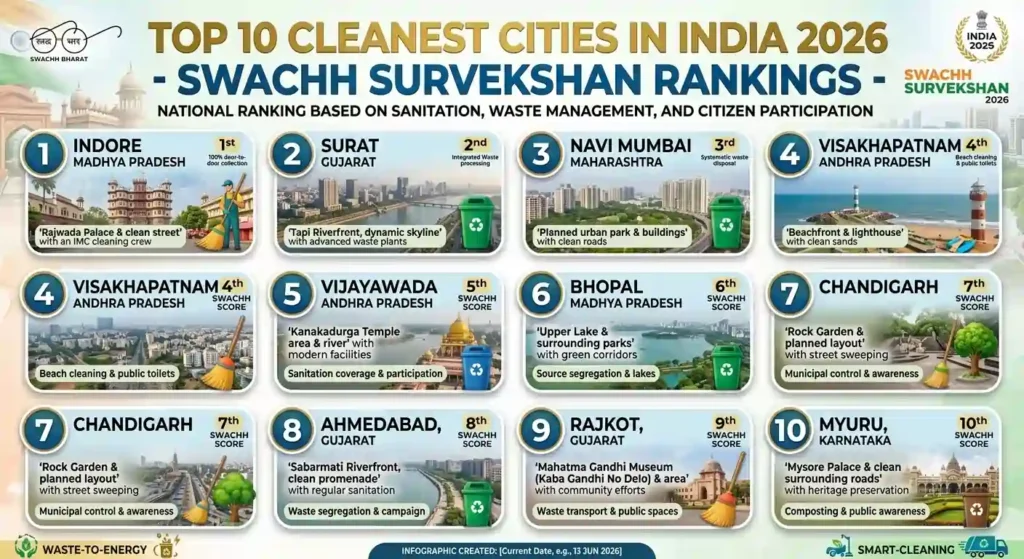
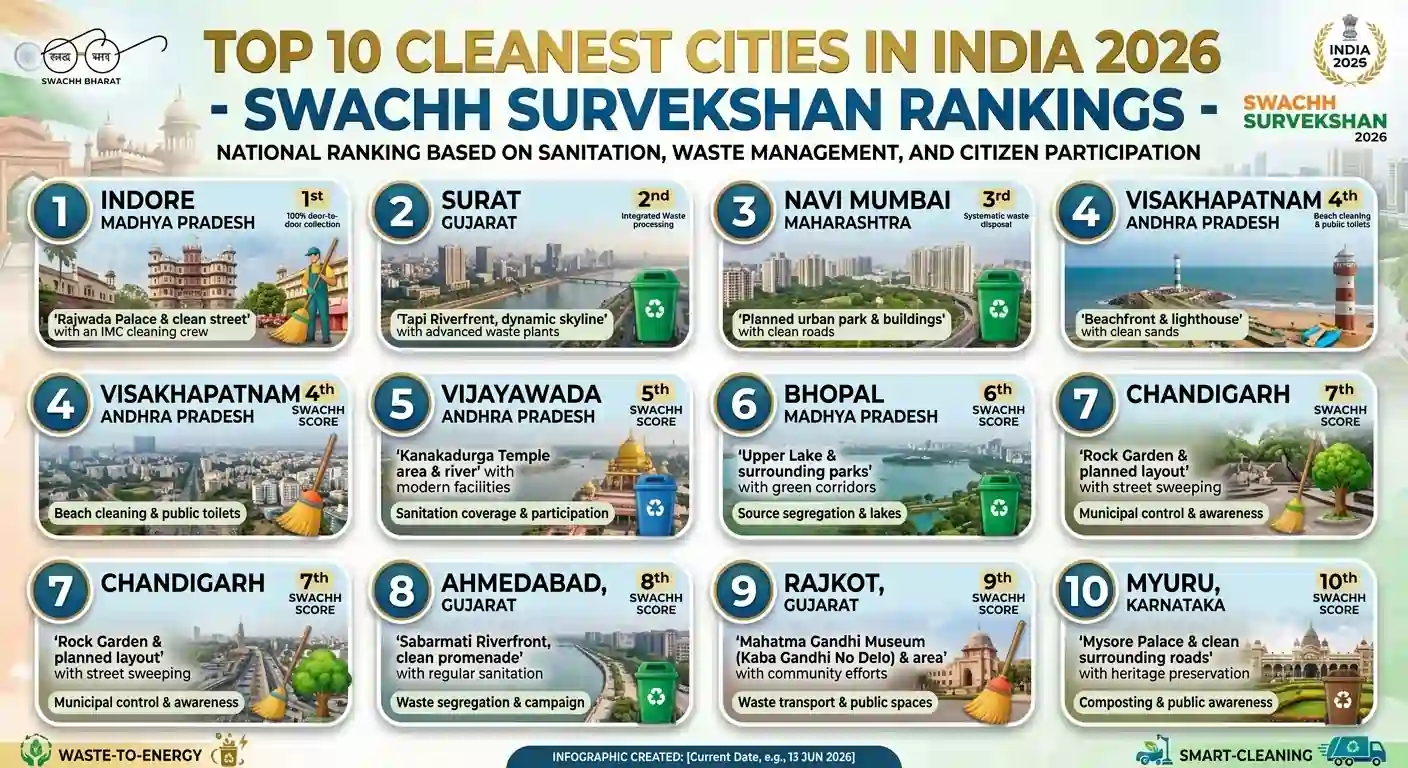
Top 10 Cleanest Cities in India 2026 – Swachh Survekshan Rankings
Based on the latest Swachh Survekshan 2024-25 survey results, here is the official top 10 cleanest cities in India 2026 ranking. These cities have demonstrated consistent excellence in waste management, sanitation infrastructure, and citizen engagement:
| Rank | City | State | Award / Status | Key Strength |
| 1 | Indore | Madhya Pradesh | 8th consecutive year at #1 | 100% door-to-door collection, 1,200 TPD waste processed |
| 2 | Surat | Gujarat | Joint winner (2025), #2 in 2026 | Garbage-Free 7-Star, advanced recycling systems |
| 3 | Navi Mumbai | Maharashtra | Consistent top 3 | Strong ODF+ status, innovative waste tech |
| 4 | Visakhapatnam | Andhra Pradesh | Consistent top 5 | Port city sanitation leadership, citizen programs |
| 5 | Vijayawada | Andhra Pradesh | Top 5 performer | Integrated solid waste management systems |
| 6 | Bhopal | Madhya Pradesh | Top 10 consistent | Strong recycling infrastructure, clean roads |
| 7 | Ahmedabad | Gujarat | Regular top 10 | Mass waste segregation, improved sanitation |
| 8 | Rajkot | Gujarat | Rising performer | Smart city waste solutions, citizen feedback |
| 9 | Gandhinagar | Gujarat | Clean capital city | Model governance, green infrastructure |
| 10 | Chandigarh | Punjab/Haryana UT | Union Territory star | Planned city advantage, legacy infrastructure |
Note: Rankings are based on the Swachh Survekshan 2024-25 results for cities with a population above 1 lakh. Smaller-city category winners include Mhow Cantonment, Sasvad, and Lonavala as standout performers.
Read Also.. Top 10 Posh Areas in Gurgaon: Best Places to Live in Gurgaon with Family
Which Is the Top 10 Cleanest City in India? – Detailed City Profiles
Let’s go beyond the numbers. Here is what makes each of these cities stand out — and why people are choosing to live, work, and invest there.
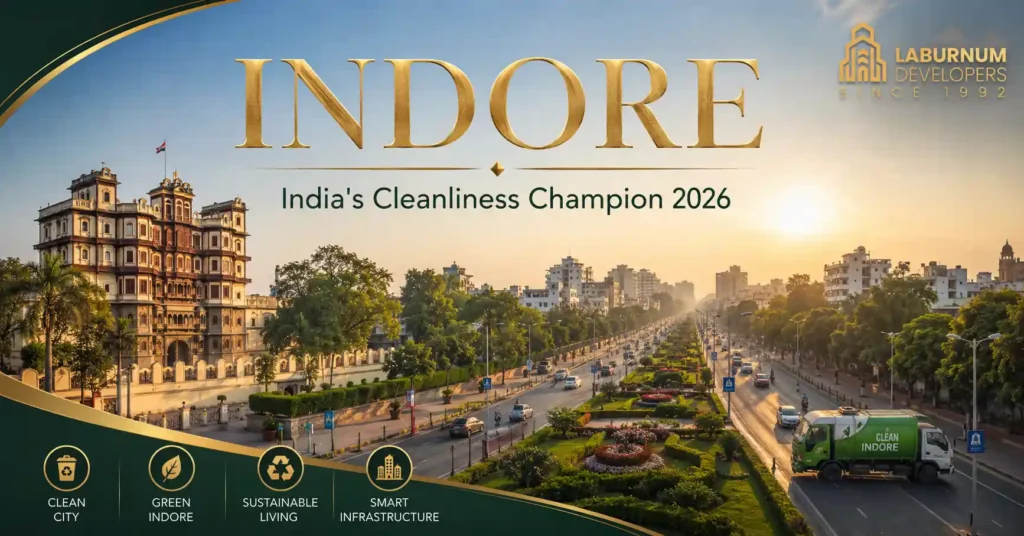
1. Indore, Madhya Pradesh: India’s Cleanliness Champion
Indore, Madhya Pradesh, is the first location in India to be dubbed the ‘Cleanliness Champion’.
Indore has been the eighth year in a row to be the cleanest city in India in 2026. That is not luck. It is a product of the concerted effort of the Indore Municipal Corporation (IMC) that has given it the shape and substance it has today.
The uniqueness of the model in Indore is the blend of technology and citizens’ behaviour. The city has 100% door-to-door waste collection, has advanced waste management facilities processing more than 1,200 tonnes of waste daily, and has very strict segregation at source; that is, collection after separation into wet waste, dry waste, and hazardous material.
Year-round, the Indore Municipal Corporation uses GPS-tracked vehicles, real-time dashboards, and public awareness campaigns. Residents who refuse to cooperate with the waste segregation rules will be fined. We have truly received the community’s cooperation in keeping the area clean, a value which has to be developed over a number of years.
The cleanliness, inhabitable nature, and a steady increase in the real estate prices of the city, the presence of an expanding IT and manufacturing base, and the infrastructural development in Indore make it an attractive combination for real estate investors. It is not surprising that Indore is on the list of fastest-growing tier-2 cities in India.
Population & Economy
- Growth Rate: 1.6% between 1980 and 2005
- Major Industries: IT, manufacturing, pharmaceuticals, education, logistics
- Economic Importance: One of the most dynamic commercial centres in Central India
Key Highlights
- India’s first-ever Smart City Integrated Command Centre is located here.
- A well-known educational centre with top-notch schools.
- Well-connected road network through the Delhi-Mumbai Industrial Corridor
- There is robust demand for real estate, both residential and commercial. There is strong demand for real estate, both residential and commercial.
- Ranked in the top 10 of the most liveable cities in India every year.
2. Surat, Gujarat: The Diamond City That Shines on Cleanliness
The improvement in Surat’s cleanliness rankings is perhaps one of the most astounding improvement stories in Indian urban history. The city was hit with a huge infestation of the plague in the mid 1990’s, necessitating a full-scale restructuring of the city’s civic systems. In the modern world that is Surat, this transformation is seen through its regular ranking in the list of the cleanest cities in India.
Surat Municipal Corporation (SMC) has a state-of-the-art system of waste recycling and processing. The city has been certified as a 7-star garbage-free city with the highest possible Swachh Bharat rating. Surat treats its dry waste at Material Recovery Facilities (MRFs) and treats wet waste as compost and biogas.
It is also one of the fastest-growing economies of India, where the country’s diamond cutting and polishing industry is situated and a rapidly expanding textile industry. High economic activity and high cleanliness standards bring about a quality environment for life and investment, which is truly a rarity in Indian urban space.

Population & Economy
- Population estimated by the Census: 10,000 or more
- Main industries: Diamonds, textiles, petrochemicals, engineering
- Economic Contribution: Processes almost 90% of the rough diamonds on the planet.
Key Highlights
- The Diamond Capital of the World
- One of the fastest-growing cities in India.
- Strong export-driven economy
- Modernisation of urban infrastructure and BRTS network.
- A significant focus area for industrial and business investments
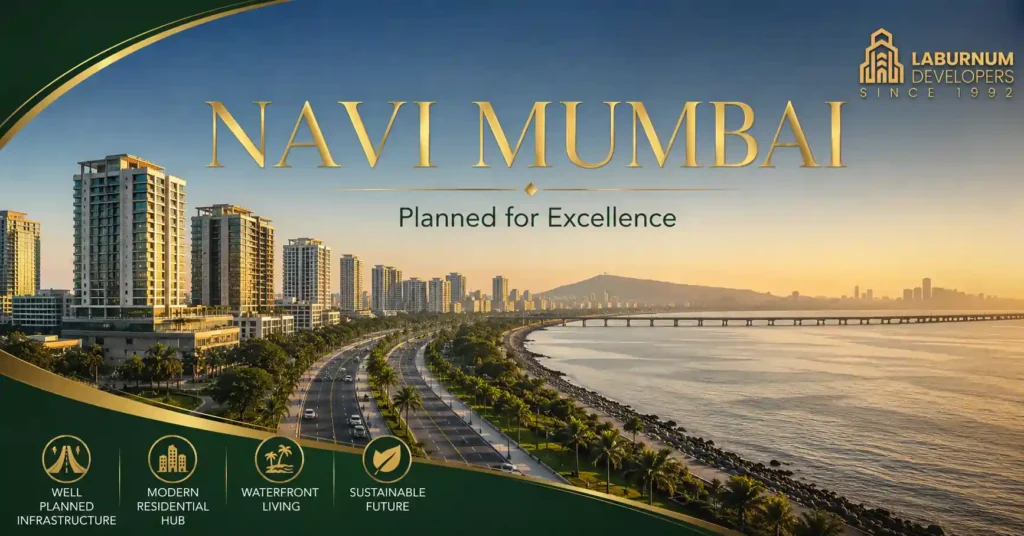
3. Navi Mumbai, Maharashtra: The Planned City That Walks the Talk
Navi Mumbai was born out of the planning to give a planned alternative to the overcrowded Island city of Mumbai. That planning benefit is reflected in the cleanliness of the area 20 years or more later. The Navi Mumbai Municipal Corporation (NMMC) has been consistently in the top three positions in Swachh Survekshan for several years due to its modern waste management infrastructure and the active participation of the people.
The city has become Open Defecation Free Plus (ODF+) and has an efficient door-to-door waste collection in all wards. The lower population density of Navi Mumbai, as compared to old Mumbai, also facilitates its cleanliness, as it is easier to monitor and enforce the regulations.
Navi Mumbai is becoming a popular choice for people who wish to buy real estate in Mumbai but don’t want to deal with the traffic and pollution of the older city. It’s a desirable place to live for families because of clean air, streets and their upkeep, and functioning civic services.
Read Also… What are Stamp Duty & Registration Charges in Gurgaon? A Complete Guide to Property Registration
Population & Economy
- Domestic animals: Approximately 1.5 million
- Areas of concentration for the service industry: IT, logistics, finance, manufacturing
- Economic significance: development of the commercial extension of the Mumbai Metropolitan Region
Key Highlights
- Housing important IT and business parks
- The international airport, which is to be built, is expected to boost growth prospects.
- Large streets and urban planning blocks.
- Strong residential and commercial real estate market
- Very good rail and road links.

4. Visakhapatnam, Andhra Pradesh: Coastal City, Clean Commitment
Visakhapatnam, or Vizag, the biggest city of Andhra Pradesh, also stands as the most regular performer in the National Cleanliness Campaign. In GVMC, sanitation has become a political and administrative priority, and it has conducted one of the best-structured door-to-door waste collection systems among the big cities in India.
The coastal environment of the city calls for high levels of cleanliness, and Vizag is up to the task. Beach cleaning and separating waste have become a city habit, and frequent public education initiatives are a city trademark. The GVMC has also upgraded its waste processing plants and is integrating smart city technologies in its sanitation activities.
With the emergence of the new capital region of Andhra Pradesh, the business and residential importance of Visakhapatnam is set to further grow. Its real estate appeal is enhanced by its cleanliness rating.
Population & Economy
- Estimated population of the area: approximately 2,300,000 people
- Key Industries: Port activities, steel, petroleum, IT, tourism.
- Economically, one of the biggest port cities of India.
Key Highlights
- Home to one of the busiest ports in India
- Gorgeous beaches and visitor-friendly sites.
- The expansion of the IT and Start-Up ecosystem.Expansion of IT and Start-Up ecosystem
- Strategic location for international trade Strategic location for international trade
- Industrial base that is strong with the presence of PSUs

5. Vijayawada, Andhra Pradesh: The Rising Performer
Vijayawada has been steadily moving up the national cleanliness lists and is the economic hub of Andhra Pradesh with an integrated approach towards urban sanitation. The city has done a lot of work in educating the people about waste segregation, has appointed waste collection workers for all zones, and has enhanced the ODF certification procedure.
The unique aspect of Vijayawada is the active engagement of the community. Resident Welfare Associations play an active role in keeping the neighbourhood clean, which is effective in enforcing cleanliness from the bottom up rather than the top down, and thus more sustainable.
Population & Economy
- Projected Population Size: approximately 1.8 million people
- Main industries: Trade, logistics, agriculture, education, health care
- The river plays an important role in the economy of Andhra Pradesh as a key commerce hub.
Key Highlights
- On the banks of the Krishna River
- An important hub of transport and logistics
- Rapid infrastructure development
- Good education and health ecosystem
- A rise in demand for housing.An increase in demand for residential properties.
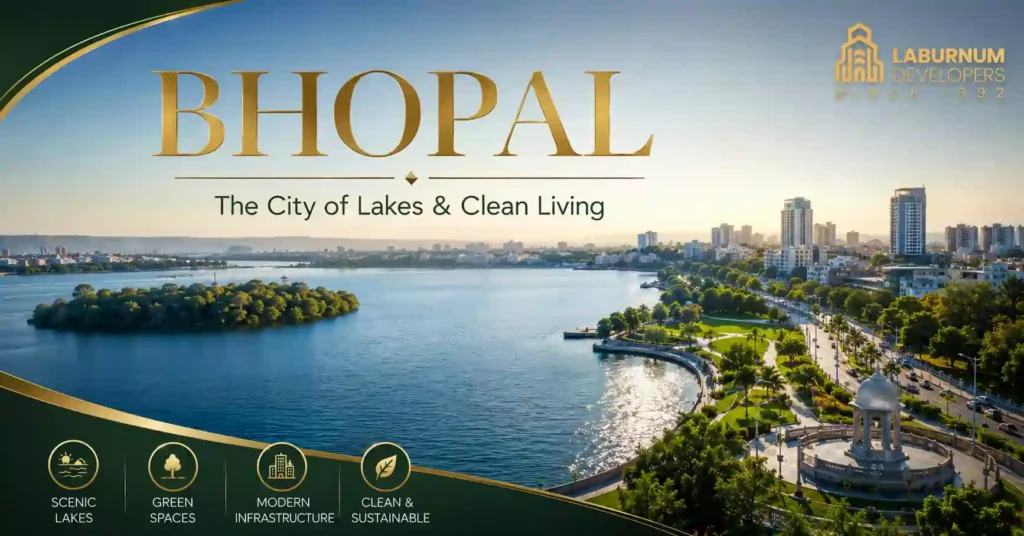
6. Bhopal, Madhya Pradesh: Consistency and Civic Discipline
Madhya Pradesh’s capital city, Bhopal, enjoys robust political commitment at the state level for the Swachh Bharat Mission. The city has dedicated heavily to recycling and composting facilities, which lessen the amount of waste sent to landfills.
To safeguard the environment, the management of waste in Bhopal’s lakes and natural areas needs to be particularly high. This challenge has been overcome by the city’s commitment to street cleaning and effective monitoring systems. It has always been a regular feature among the cleanest 10 cities in India and stands firm each year.
Population & Economy
- Estimated Population: Around 2.5 million
- The major industries are government services, manufacturing, information and communication technology (ICT), and education.
- Madhya Pradesh is a state; the administrative and educational hub of Madhya Pradesh is here.
Key Highlights
- The City of Lakes is also called
- High level of government and public sector involvement
- A rich historic and cultural background
- Establishing an IT and start-up ecosystem
- Very good life quality indicators

7 to 9. Gujarat’s Triple Crown
Three cities of Gujarat — Ahmedabad, Rajkot and Gandhinagar — have a place in the top 10, a pointer to the state’s consistently good performance in urban sanitation. Gujarat has developed a tradition of municipal accountability that extends beyond the size of the population.
In Ahmedabad, waste segregation programmes have been scaled up in the huge residential and commercial areas. Rajkot has adopted smart city waste solutions and has scored a high level of citizen feedback. The city of Gandhinagar is one of the most planned cities in India, and its urban layout makes the management of cleanliness easier.
Chandigarh is the sole UT in the top 10 list, which is characteristic of the unique planned history of the city and a legacy of institutional discipline due to the shared administration by the Punjab and Haryana governments. The wide roads, green spaces, and the urban planning of Chandigarh play a significant role in its cleanliness performance.
Population & Economy Snapshot
7. Ahmedabad
Population: Over 8 million
Key Industries: apparel and bedding, pharmaceuticals, financial, manufacturing
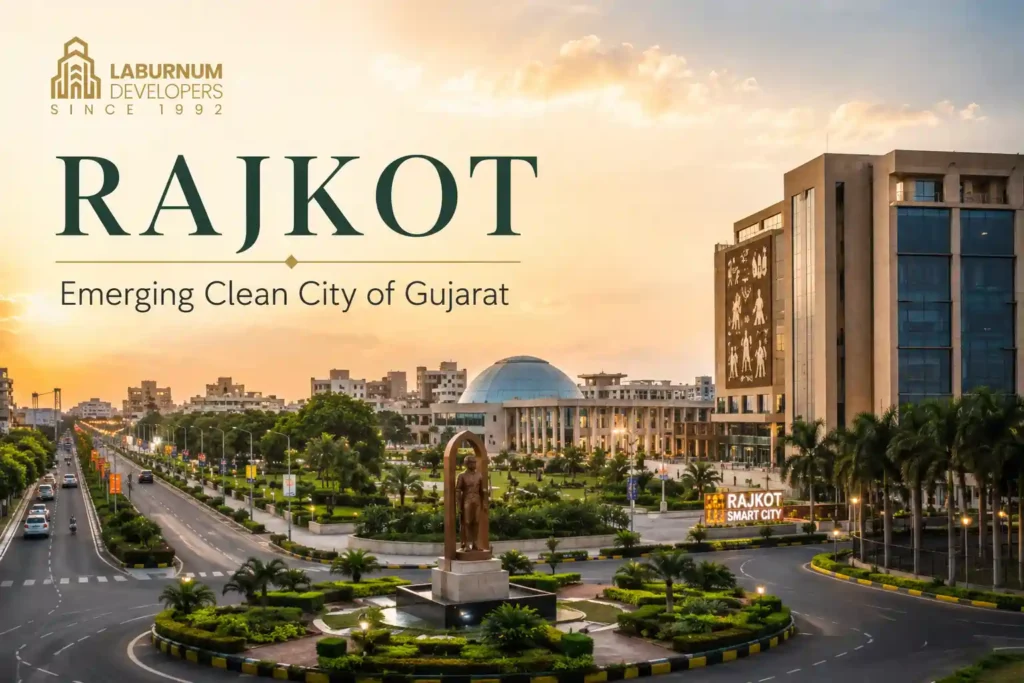
8. Rajkot
Population: Around 2 million
Key Industries: Engineering, automotive components, and manufacturing of automotive components and foundries.
9. Gandhinagar
Population: Around 400,000
Key industries: Government administration; Information and Communication Technology (ICT); Education.

10. Chandigarh: India’s Best-Planned Union Territory
It has been Chandigarh’s consistent ranking among the cleanest cities in India that has kept it the only Union Territory to do so. The city has a well-planned layout based on sectors, wide roads, ample green spaces, and efficient civic management, all designed by Le Corbusier. The Municipal Corporation Chandigarh (MCC) has made efforts to improve cleanliness by conducting door-to-door garbage collection, segregation at source, scientific processing of garbage, and engaging and sensitising the community.
Chandigarh, an administrative, educational, and healthcare hub, is the joint capital of Punjab and Haryana. It ranks among the most liveable cities in India for its excellent infrastructure, high literacy rate, and quality of life.
Population & Economy:
- Estimated Population (EP): more than 1.2 million.
- Literacy Rate: Over 86%, which is one of the highest in the country of India.
- Key Industries: Government services, education, health care, IT, tourism, real estate.
Key Highlights:
- The first planned city of independent India!
- Home of Sukhna Lake and Rock Garden
- Higher income per capita and a robust service sector.
- Large open green spaces and clean public spaces.
- To be a city consistently on the list of the cleanest and most liveable cities in India.
Top 5 Cleanest States in India 2026 – State-Level Rankings
Beyond individual cities, the Swachh Survekshan also evaluates states on their overall urban cleanliness performance — looking at how well all Urban Local Bodies (ULBs) within a state are performing across all indicators. This state-level ranking offers a broader picture of which states are genuinely committed to clean urban governance.
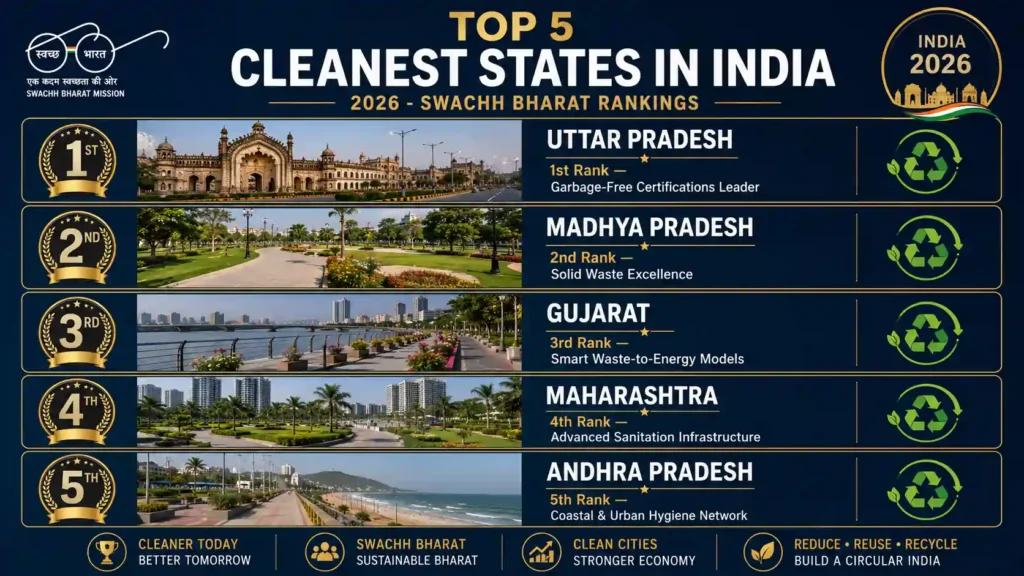
Here are the top 5 cleanest states in India as per Swachh Survekshan 2024-25:
| Rank | State | Key Contributing Cities | Why It Ranks High |
| 1 | Madhya Pradesh | Indore (#1) + Bhopal (#6) + strong tier-2 performance | Consistent top state, institutionalised cleanliness model |
| 2 | Gujarat | Surat, Ahmedabad, Rajkot, Gandhinagar all in top 10 | State-wide accountability and smart city integration |
| 3 | Maharashtra | Navi Mumbai + strong performance across ULBs | Strong ODF certification rates, modern waste tech |
| 4 | Andhra Pradesh | Visakhapatnam + Vijayawada twin performers | Coastal governance, citizen-driven sanitation programs |
| 5 | Uttar Pradesh | High garbage-free city certifications, large ULB base | Recent rapid improvement; Noida emerging as clean performer |
State-Level Deep Dive: What Sets These States Apart?
Madhya Pradesh
The presence of Indore in the state is directly responsible for the dominance of Madhya Pradesh at the state level. The MP government has adopted Indore’s model and conducted training sessions for smaller city officials and introduced technology solutions across the state. It is an improvement across all levels for all ULBs in the state.
Gujarat
Gujarat’s regular features in the top 5 cleanest states are an example of a different model — one where the city is well-governed, private sector partners drive initiatives, and the attitudes of its people focus on business-friendly, clean cities. Gujarat was also an early adopter of the Smart Cities Mission, and the information infrastructure created under the mission is assisting in the monitoring of sanitation.
Maharashtra
Urban sanitation management is a complex challenge in the highly populated state of Maharashtra, where the state is doing more than its fair share. The presence of other consistent performers like Navi Mumbai, Pune, and Nashik provides cushioning to the state rankings despite the cities being smaller when they are struggling.
Andhra Pradesh
With only two major towns in the state – Vizag and Vijayawada – Andhra Pradesh has a decent state-level performance. The new state government has made huge investments in sanitation systems in both cities as part of plans to develop urban areas.
Uttar Pradesh
Uttar Pradesh’s improvement to the top 5 clean states is a true success story. The number of Urban Local Bodies in the Indian context is huge (more than 700), making it extremely difficult to rank all at the state level. This is the result of good investments in garbage-free town certifications in tier-2 and tier-3 cities by UP.
What Makes a City Stay Clean? The 5 Pillars That Drive Rankings
It is one thing to perform well in a single survey year. Staying at the top for multiple years requires something deeper — a system that works regardless of which political party is in power or which officer is running the municipal corporation. Here are the five pillars that separate India’s consistently cleanest cities from the rest:
1. Technology-Driven Waste Monitoring
Top-performing cities like Indore and Surat use GPS-tracked waste collection vehicles, real-time monitoring dashboards, and IoT-based bin sensors. This technology allows municipal corporations to identify inefficiencies, track worker attendance, and respond to complaints in hours rather than days.
2. Strict Source Segregation Enforcement
Cities that rank consistently high have achieved something difficult: they have changed citizen behaviour. Households in Indore, Surat, and Navi Mumbai separate wet and dry waste before it is collected — a fundamental shift from the mixed-waste model that creates landfill crises in lower-ranked cities.
3. Citizen Participation and Feedback
Swachh Survekshan allocates a significant weightage to citizen feedback — approximately 35% of the overall score. Cities that maintain high scores year after year have built genuine community ownership over cleanliness. Local resident welfare associations, school programmes, and mohalla cleanliness teams all play a role.
4. Political and Administrative Continuity
Clean cities rarely become clean overnight. The best performers have maintained consistent administrative focus on sanitation across electoral cycles. When political leaders make cleanliness a priority — and hold civil servants accountable — the results are visible and measurable.
5. Integration with Urban Development
The top cleanest cities are not treating sanitation as a standalone programme. They integrate waste management into broader urban planning decisions — road layouts, market design, residential zoning, and public space development. Cities built with cleanliness in mind are far easier to keep clean than cities retrofitting sanitation onto legacy urban structures.
Clean Cities and Real Estate: Why This Matters for Home Buyers
You may be thinking, what does all this have to do with home buying or real estate investing? Most people are not aware of the more direct connection.
Cleanliness rankings are a proxy for the quality of urban governance. A city with healthy management of its waste, sanitation regulations, a clean environment, and open areas will also have clean and well-maintained roads, functional infrastructure, and efficient civic services. That’s the kind of things that make a city a good place to live – and something that helps sustain property values.
Given the growing body of evidence from Indian and international real estate data, it is clear that property values in cleaner and better-maintained cities are likely to rise quicker and to yield lucrative rent rates. Investors should consider the civic health of the city, rather than just the price per square foot now.
This is particularly relevant if you’re considering Gurgaon. In the state of Haryana, the government has been making massive investments in smart city infrastructure in urban centres, and Gurgaon is continuing to expand new areas with modern planning practices. This trend towards more planned and liveable cities is being manifested in premium residential developments in well-planned areas, such as Laburnum Developers’ ‘Builder Flats’.
For those looking for a luxury residential offering in Gurgaon, check out luxury builder floors in some of the most connected and well-planned sectors of Gurgaon – the Victory Floors Sector 63A and the Victory Floors Sector 88A, both by the hand of Laburnum Developers.
Frequently Asked Questions (FAQs)
Q1. Which is the cleanest city in India in 2026?

Indore in Madhya Pradesh becomes the cleanest city in India in 2026 based on the results of the Swachh Survekshan 2024-25. The cleanest city in India in 2026 is Indore in Madhya Pradesh, as per the results of the Swachh Survekshan 2024-25. It’s getting the same title for eight consecutive years, the most for any Indian city. The Indore Municipal Corporation’s innovative approach with 100% door-to-door collection, stringent source segregation rules, and citizens’ participation has set the standard for sanitation in Indian cities.
Q2. Which are the top 10 cleanest cities in India?

The top 10 cleanest cities in India 2026 (1 lakh population and above) are: Indore, Surat, Navi Mumbai, Visakhapatnam, Vijayawada, Bhopal, Ahmedabad, Rajkot, Gandhinagar, and Chandigarh. These cities have received awards for excellence in waste management, sanitation systems, and citizen participation as part of the Swachh Survekshan initiative.
Q3. What are the top 5 cleanest states in India?
Madhya Pradesh (1st), Gujarat (2nd), Maharashtra (3rd), Andhra Pradesh (4th), and Uttar Pradesh (5th) are the top 5 cleanest states for the nation in Swachh Survekshan 2024-25. It is to be noted that Madhya Pradesh leads the list mostly due to the domination of Indore and the state government’s efforts to successfully replicate this in smaller towns and cities.
Q4. How does the Swachh Survekshan ranking work?
Swachh Survekshan is an annual survey by the Ministry of Housing and Urban Affairs (MoHUA) under the ‘Swachh Bharat Mission’. Cities are assessed based on three main areas: Service Level Progress (waste collection, processing, ODF certification); Certification and Direct Observation (physical assessment by third-party quality council teams); and Citizen Voice (direct feedback from citizens). Cities are ordered within each of the population categories to ensure a level playing field for smaller cities and metros.
Q5. Is Gurgaon on the list of the cleanest cities in India?
In the last few years, Gurgaon (Gurugram) has been climbing up its rank in Swachh Survekshan, but it is not currently in the national Swachh Survekshan top 10 cities list. Common problems the city is dealing with are those of rapid urban growth, controlling construction waste, sanitation in new areas, and extending waste collection to a vast area. However, a few new clusters of housing societies in Gurgaon, especially in the vicinity of the Dwarka Expressway and Golf Course Extension Road, boast modern infrastructure to ensure a clean environment.
Q6. Why is cleanliness important when buying a home?
Cleanliness is a strong indicator of the quality of civic governance in a city. Cities that perform well in Swachh Survekshan tend to also have better roads, reliable utilities, and more responsive municipal services — all of which affect the day-to-day quality of life for residents. From a real estate investment perspective, well-governed, cleaner cities also tend to support stronger long-term property value appreciation and higher rental yields. When choosing between locations for a home purchase, adding cleanliness rankings to your evaluation criteria is a smart move.
Q7. Which Indian city has won the most Swachh Survekshan awards?
Indore has won the Swachh Survekshan for 8 years in a row (from 2017-2024-25) and is the city with the maximum number of Swachh Survekshan wins. A similar uniformity at the national level has not been achieved in any other Indian city. Surat has been the nearest competitor and has been joint top in 2025, and it has been in second place in recent years.
Q8. Can a smaller city be cleaner than a metro in India?
Yes — and the data of Swachh Survekshan substantiates it. The cities that have regularly been topping their category are Mhow Cantonment (Madhya Pradesh), Sasvad (Maharashtra), and Lonavala. Smaller cities may benefit from sanitation management as they tend to be less dense, have shorter waste collection routes, and have a sense of togetherness within the community. The Swachh Survekshan has taken a unique approach of categorising the population-based list to recognise small clean cities and give them the respect they deserve.
Conclusion: Clean Cities, Smart Choices
India’s Cleanest Cities 2026 is a testament to the possibility that can be achieved when governments make urban sanitation a measurable and accountable achievement. In the last 8 years, from Indore’s dominance to Surat’s metamorphosis from a city plagued with diseases to a global model of cleanliness, the Indian urban future is truly clean, liveable, and aspirational.
The India clean city list is a fact of interest for home buyers and investors. It offers a glimpse into the extent of civic good governance, the future of neighbourhoods, and the type of community in which your family will choose to live. Cleanliness is not a luxury parameter — it is a parameter of quality of life.
Laburnum Developers is your answer to seeking a home in a well-planned, well-connected, and well-developed home area in Gurgaon! With the city making every effort to make it a better place to live, our luxury builder floors across Dwarka Expressway and Golf Course Extension Road cater to those who value space, privacy, and quality.
Check out our projects on laburnumdevelopers.com or contact our team at +91-9967676796. We’re here to answer your questions and answer them without pressure, seven days a week.
Read Also… Top 5 Posh Areas in Gurgaon | Best Places to Live in Gurgaon
Read Also… Stilt+4 Floor Rule in Gurgaon: What Buyers Must Know




Ambience Mall Gurgaon: Location, Shopping & Dining 2026
June 17, 2026 - 8:05 am[…] Read Also.. Top Cleanest Cities in India 2026 […]
Vastu Tips For Home Flooring | Vastu Shastra 2026 Guide
June 17, 2026 - 11:16 am[…] Read Also.. Top 10 Cleanest Cities in India 2026: Latest Swachh Survey Rankings […]
Why Rosewood City Sector 49 Gurgaon Is Top Choice In 2026
June 18, 2026 - 11:48 am[…] Read Also… Top 10 Cleanest Cities in India 2026: Latest Swachh Survey Rankings […]
Sector 89 Gurgaon: Price Trends & Best Projects 2026
June 19, 2026 - 10:35 am[…] Read Also.. Top 10 Cleanest Cities in India 2026: Latest Swachh Survey Rankings […]
TOP 10 Richest Cities: GDP 2026 India's Wealthiest Cities
June 23, 2026 - 1:12 pm[…] Read Also.. Top 10 Cleanest Cities in India 2026: Latest Swachh Survey Rankings […]
How To Evaluate Luxury Builder Floor Projects In Gurgaon
July 8, 2026 - 10:36 am[…] Read Also ……. Top 10 Cleanest Cities in India 2026: Latest Swachh Survey Rankings […]
Top 10 Residential Projects In Gurgaon 2026 - Laburnum
July 25, 2026 - 12:10 pm[…] Read Also…. Top 10 Cleanest Cities in India 2026: Latest Swachh Survey Rankings […]
Best Sectors To Invest In Gurgaon In 2026 | Laburnum
August 5, 2026 - 12:24 pm[…] Read Also... Top 10 Cleanest Cities in India 2026: Latest Swachh Survey Rankings […]
Gurgaon Property Investment Guide For First-Time Buyers 2026
August 11, 2026 - 12:20 pm[…] Read Also… Top 10 Cleanest Cities in India 2026: Latest Swachh Survey Rankings […]
Top 10 Metro Cities In India: Metropolitan Cities List 2026
September 9, 2026 - 7:44 am[…] Related More … Top 10 Cleanest Cities in India 2026 […]
Skgupta
September 9, 2026 - 2:38 pmमध्यप्रदेश राज्य को स्वच्छ राज्य के रूप में पहला स्थान मिला है।खुशी की बात है। क्या मध्यप्रदेश के सभी नगरों की स्वच्छता रैंकिंग सहित एक सूची उपलब्ध करा सकते हैं? इससे नगरों के प्रशासन से सम्बद्ध अधिकारियों में अपने नगर की रैंकिंग सुधारने के लिए प्रोत्साहन मिलेगा। धन्यवाद।