



Table of Contents
A Construction-Linked Plan CLP in real estate is a method of paying for a house in phases. Each phase corresponds to a step in the construction process—for example, paying for the foundation, the slab, and the finishing work. You don’t pay for work that is not built.
This guide provides simple answers to the most common questions relating to CLP in real estate. You will learn what CLP in real estate is, how a CLP payment plan works, and how it differs from a PLP, a TLP, and a down payment plan. You will also find sample construction schedules, relevant rules of RERA and GST, and a checklist for home buyers.
Note: All the illustrative examples in this post may not be named. Always read your sale agreement before paying.
CLP in Real Estate: The Quick Answer
This post provides a detailed analysis of CLP in real estate. However, if you want a quick summary, see this.
- Why it matters: CLP in real estate is the most common method of payment in India for under-construction homes.
- CLP full form: CLP full form is Construction Linked Plan or Construction Linked Payment Plan.
- How it works: CLP in real estate means paying a share of the price for the house at each stage of construction.
- Best for: People who want to reduce the risk associated with buying a house under construction.
- PLP: Possession Linked Plan. You pay a small share early and most at possession.
- TLP: Time Linked Plan. You pay on fixed dates, regardless of progress.
- Down-payment plan: You pay most of the price upfront, often for a discount.
- Legal cap: Under RERA Section 13, a builder cannot take more than 10% before a registered agreement for sale.
What Is CLP in Real Estate?
CLP stands for the Payment Plan for an under-construction property. Under a CLP, the builder charges the client as per the construction progress. Therefore, payments are made progressively.
What is CLP? Meaning and Full Form
Many buyers search “what is CLP” before they book. Here is the plain answer.
- C stands for Construction.
- L stands for Linked.
- P stands for Plan (or Payment Plan).
Therefore, CLP means a plan in which the client is charged as per construction progress. Some builders also use terms like ‘pay as you build’ or ‘slab-wise’ to refer to CLP.
CLP Meaning in Simple Words
Let’s say you hire a contractor to build a wall. You will not pay him the entire fee on the first day. You pay him upon completion of each part of the job. CLP works the same way.
Common Construction Stages for CLP in Real Estate
Some common construction stages that are generally incorporated in a CLP are:
- Booking amount
- Agreement for Sale
- Excavation/Foundation
- Plinth or stilt level
- Each floor slab, one by one
- Completion of Brickwork and Plastering
- Flooring and fittings
- Offer of Possession
Stage names differ by project. A low-rise builder floor has fewer slabs than a tall tower. So the schedule for a builder floor is usually shorter.
Why CLP in Real Estate Became the Default Plan
CLP stands for ‘Construction Linked Plan’. Ask any agent which plan buyers choose the most, and you will hear, ‘CLP in Real Estate’. There are three major reasons for this.
It’s Consistent With Banks’ Lending Method
In the case of under-construction homes, banks release home loans in stages and, therefore, ask for payment demands and release loans in stages. Thus, for such cases, CLP works best, since payment demands and payment releases happen in sync, thus simplifying paperwork.
It Fits RERA’s Spirit
RERA aims at linking buyers’ money to the physical progress of the real project. Similarly, in a CLP in Real Estate, buyer money gets linked to the physical construction on the site, and the builder receives funds for further construction.
It Establishes Trust
Progress on construction gives buyers assurance and peace of mind. An organized and staged plan gives buyers the chance to visit the construction site. It helps the builder create a public, organized record of his/her progress on construction.
How a CLP Payment Plan in Real Estate Works
The process is simple once you see it step by step.
- When the home is booked, a booking amount is paid. RERA limits the advance to 10% of the sale price until the sale agreement is registered.
- The sale agreement is signed and registered. The agreement mentions the payment schedule.
- The builder reaches a construction stage and raises an invoice for the stage to the customer.
- The builder raises a demand letter. It states the stage and the amount due.
- You pay within the time specified in the agreement. If you use a home loan, the bank releases the money.
- This process is repeated until possession is given by the builder. The last payment is made on possession.
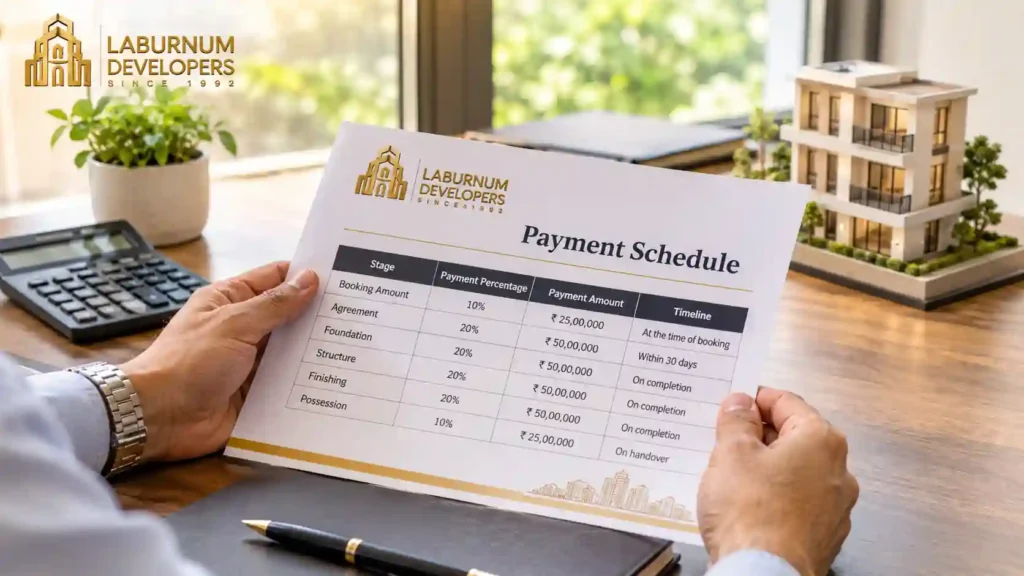
A Sample CLP Schedule (Illustration)
This illustration is based on a price of ₹2.5 crore and shows how a CLP may look. It is for illustration only and is not prepared by Laburnum. Nor is it for any real project.
| Stage | Share of price | Amount |
|---|---|---|
| Booking | 10% | ₹25 lakh |
| Agreement for sale | 10% | ₹25 lakh |
| Foundation complete | 10% | ₹25 lakh |
| Plinth / stilt slab | 10% | ₹25 lakh |
| Ground floor slab | 10% | ₹25 lakh |
| First floor slab | 10% | ₹25 lakh |
| Second floor slab | 10% | ₹25 lakh |
| Third floor slab | 10% | ₹25 lakh |
| Brickwork and plaster | 10% | ₹25 lakh |
| Offer of possession | 10% | ₹25 lakh |
| Total (before GST) | 100% | ₹2.5 crore |
If GST is applicable, it is paid with each instalment.
How a Home Loan Helps
Home buyers generally take a loan in conjunction with a CLP. The bank releases funds to the builder upon completion of each stage, and the buyer pays interest only on the released amount.
A Pre-EMI Example
Let’s say the interest rate is 9%.
- Loan approved: Rs. 2 crore
- Amount released: Rs. 80 lakh
- Interest on released amount: about Rs. 60,000
Why This Matters for Your Cash Flow
If the entire Rs. 2 crore was released, the interest would be about Rs. 1.5 lakh each month. The interest-only phase before EMI is called Pre-EMI. Hence, a CLP (Construction Linked Plan) in real estate eases your cash flow during Pre-EMI.
When Is Full EMI Due?
Full EMI is due when the bank releases the entire loan. This usually happens when possession is given. Full EMI is not due at the beginning. Plan your budget for that date.
The rate here is an approximation. Contact your bank to know the rate.
Types of Payment Plans in Real Estate
CLP is the most common. Others include:
| Plan | Full form | Core idea |
|---|---|---|
| CLP | Construction Linked Plan | Pay at construction milestones |
| PLP | Possession Linked Plan | Pay most at possession |
| TLP | Time Linked Plan | Pay on fixed dates |
| DPP | Down-Payment Plan | Pay most upfront |
| Flexi plan | Flexi Payment Plan | Mix of upfront and stage payments |
Let us look at each in detail.
PLP in Real Estate: Possession Linked Plan
PLP in real estate means you pay a small amount at booking and the balance at possession.
How PLP Works
- You pay about 10% to 25% at booking.
- You pay little or nothing during construction.
- You pay between 75-90% of the cost at possession with a PLP.
Exact splits vary, and the numbers are specific to your agreement.
Advantages of a PLP in Real Estate
- Lower cash outflow during construction
- No or low pre-EMI
- You pay the bulk only when the home is ready
Disadvantages of a PLP in Real Estate
- You need to pay the bulk at possession, which means you need a large cash outflow or loan at possession
- The price of the home may be higher compared to a home which is funded by the builder, because the builder funds the construction for a longer time
- If you take a loan at a later date, there may be delays, and you may not have enough time to pay the loan.
PLP works well for buyers who want to make low payments during construction and have confidence in the builder.
TLP in Real Estate: Time Linked Plan
A TLP means that you pay on fixed dates on a calendar. Payments can be monthly, quarterly, or half-yearly.
How TLP Works
The builder determines the dates. For example, you may have to pay 30% at booking, an additional 30% after 6 months, and the remaining 40% at possession.
Benefits of TLP in Real Estate
- You can make payments at scheduled times in advance and budget accordingly.
- Some builders may provide a discount if you pay on time.
Cons of TLP in Real Estate
- You may pay even when work lags
- You carry more risk than with a CLP
- It is less common today than CLP
Many people believe that TLP gives the buyer less control; as with a CLP, your payment is linked to the progress of construction.
A Down-Payment Plan Explained
A down-payment plan requires customers to pay the majority of the price up-front. Builders normally ask for 10%-15% at the time of booking, and the rest 30-60 days after. Some plans leave behind a small final amount to be paid at the time of possession.
Why do Builders Offer a Discount?
Builders take the cash up front, and that lowers their cost of funds. In such a case, discounts are offered by builders. According to industry sources, discounts range between 3%-10%.
Pros of a Down-Payment Plan
- Price discount
- Fewer installments
- Easy payments
Cons of a Down-Payment Plan
- You pay most of the price before the construction is complete.
- There is a high risk of project stalling.
- Requires a large up-front payment or an early loan.
A down-payment plan is suitable for near-complete or complete homes only. It is also suitable for customers who have prior experience dealing with the builder.
What About Flexi Plans?
A flexi plan is a combination of a CLP and down-payment plan. Under a flexi plan, the customer pays around 30-50% up-front, and the rest is paid in smaller, staged payments. It is between a down-payment plan and CLP.
CLP vs. PLP vs. TLP vs. Down-Payment Plan: Side-by-Side
Use this table to compare all four.
| Feature | CLP | PLP | TLP | Down-Payment Plan |
|---|---|---|---|---|
| Payment trigger | Construction stage | Possession | Calendar date | Booking, then 30–60 days |
| Money paid early | Low to medium | Lowest | Medium | Highest |
| Risk if project stalls | Low | Low cash risk | Medium | High |
| Discount | Rare | Rare, may carry a premium | Small, if any | Often 3%–10% |
| Pre-EMI burden | Gradual | Minimal | Moderate | Heavy, early |
| Best for | Cautious buyers | Low cash flow now | Fixed-budget planners | Cash-rich buyers |

Sources: industry explainers such as Realatic’s plan comparison. Ranges differ by developer.
A Simple Way to Understand the Risk
Imagine a project stalls after the plinth stage. Here is approximately how much you would have paid for each plan.
- CLP: About 30-40% of the price
- Down-payment Plan: About 80-90% of the price
- PLP: About 10-25% of the price
- TLP: Depends on the dates; may be more than a CLP
Most cautious buyers choose CLP when buying under-construction properties.
A Worked Example: One ₹2.5 Crore Home Under Four Plans
To understand better, let’s take the example of a 2.5 crore home (base price). Now imagine the early payments for each of the other plans and change the price accordingly.
Note: The numbers are for example’s sake; real numbers will vary.
Assumptions about the timing of payments impact how you assess the various payment plans offered by a builder.
| Plan | Assumed price | Assumed paid in first 12 months | Amount paid early |
|---|---|---|---|
| CLP | ₹2.5 crore (no change) | About 30% | About ₹75 lakh |
| Down-payment plan | ₹2.375 crore (5% discount) | About 90% | About ₹2.14 crore |
| PLP | ₹2.575 crore (3% premium) | About 15% | About ₹38.6 lakh |
| TLP | ₹2.45 crore (2% discount) | About 40% | About ₹98 lakh |
What the Table Shows
A down payment plan saves roughly ₹12.5 lakh on price. However, you end up paying around ₹1.39 crore in the first year with a down payment plan compared to a construction-linked plan (CPL).
The extra money that you pay with a down payment plan would be available to the builder approximately two years earlier than with a CLP. Assuming a 9% cost of money, that would roughly cost ₹25 lakh. That is almost twice the discount.
A larger discount does not always mean a better deal. You need to count the cost of early payment and the risk as well.
Where PLP Wins
PLP in real estate requires the least from you in year one. If you don’t have money to spare, that matters. But you pay a premium, and you need a large sum at possession. Check your loan eligibility for that final payment and book only if you are certain.
Where TLP Sits
TLP in real estate is in the middle price-wise and requires early payments. The weak point for TLP is the fixed calendar. If the project runs behind schedule, your payments don’t.
Benefits of CLP in Real Estate
A CLP payment plan in real estate offers clear advantages.
- Pay as the home rises. Your money is tied to real progress.
- Exposure is lower. If work stops, you have paid less.
- Loan fit. Banks release funds in matching stages.
- Transparency. The schedule is in your agreement.
- Gradual Pre-EMI. Interest grows slowly.
- Easier Planning. Milestones are listed in advance.
Who Benefits Most From CLP in Real Estate?
- First-time buyers
- Salaried families using a home loan
- Buyers who prefer lower risk over a discount
- Any first-time buyer from a developer
Drawbacks and Risks of CLP in Real Estate
No plan is perfect. Be honest about these points.
- Usually no discount. A CLP rarely carries the price cut a down-payment plan offers.
- Pre-EMI plus rent. You may pay interest and rent while you wait for possession.
- Milestones can come rapidly. A quick builder may raise several demands in a short span.
- Delays still occur. A CLP reduces your risk, but eliminating all risk is impossible.
- Weak certification. If an engineer or architect hasn’t verified a stage, that demand may be premature.
How to Reduce the Risks of CLP in Real Estate
- Always ask to see the Engineer/Architect certification
- Visit the Site before making a big payment
- Compare the stage against the RERA project updates
- Keep a cash buffer for Pre-EMI and rent
RERA, GST and other Rules Every CLP in Real Estate Buyer Should Know
The law protects you, only if you know it.
The 10% Rule Under RERA Section 13
As per RERA, no builder is entitled to accept more than 10% of the total consideration as the advance payment prior to signing and registering the agreement for sale. If a builder asks for more than that, you are well within your rights to ask for the signed agreement first. You may want to look at Into Legal World for more details.
The 70% Escrow Rule
As per RERA, a promoter is required to keep 70% of funds collected from buyers of a project in a separate project account. The promoter is required to spend the funds for the purpose of construction of the project and for payment towards the cost of land.
GST on Instalments
From the 1st of April 2019, the rate of GST on under-construction residential properties has been 5%, with ITC (Input Tax Credit). Affordable housing has been charged a lower rate of 1%. Completed residential projects (which are sold with an occupancy certificate) are exempt from GST.
TDS on Property Purchases
As per Section 194-IA, if the consideration for the purchase of property is more than INR 50 Lakhs, the buyer is required to deduct TDS at the time of payment. You should consult your tax advisor for more details.
Interest on Delay
According to RERA, in case a builder does not deliver the project by the stipulated time, and you continue to occupy the unit, you are entitled to claim interest on the amount paid for the unit. The rate of interest is decided by the state.
This information is only for your general knowledge. You are advised to consult a lawyer for the most updated and applicable laws.
CLP in Real Estate for Builder Floors in Gurgaon

Builder floors are low-rise floors. A normal project has 4 floors and stilt parking. This means fewer slabs as compared to a high-rise building.
What This Means for CLP in Real Estate
The schedule often has fewer stages.
- Each step can bear a higher price.
- This also means that construction can progress faster than in a high-rise building.
Always check the exact milestones in your agreement. Do not assume they match another project.
What if the Home is Already Constructed?
A ready-to-move-in home means construction is already completed. In this case, CLP does not apply. You purchase a completed home by taking a loan against it. The loan disbursement happens at the time of possession. Generally, a project that has all the homes completed and an occupancy certificate is exempt from GST. This needs to be confirmed by the developer and a tax advisor.
Victory Floors Sector 63A is a ready-to-move project by Laburnum Developers. Here you pay only after the home is completed.
Under-Construction Options
Laburnum Developers also has under-construction projects. These include Laburnum Homes Sector 82A and Victory Floors Sector 89. Payment options can differ by project and unit. Ask the sales team for the current schedule and plan options before you book.
You can also compare homes on our page for 3 BHK builder floors in Gurgaon and 4 BHK builder floors in Gurgaon.
Which Payment Plan Should I Choose?
This also depends on the developer and your risk appetite.
| Your situation | Plan to consider |
|---|---|
| First-time buyer using a home loan | CLP in real estate |
| Limited savings now, steady income later | PLP in real estate |
| Fixed budget and a trusted developer | TLP in real estate |
| Large savings and a near-ready project | Down-Payment Plan |
| Savings plus a wish for some discount | Flexi plan |
| Want to see the home first | Ready-to-move home |
Five Questions to Ask Yourself
- How much cash can I pay in the first six months?
- Can I handle pre-EMI and rent together?
- Do I trust this developer’s record?
- Am I okay with taking a discounted price?
- How soon do I need to move in?
Is safety your priority? Think CLP in real estate. If savings are your priority, consider a down payment plan, but only with good developers.
Common Myths About CLP in Real Estate
Many buyers hold wrong ideas about payment plans. Let us clear them up.
Myth 1: CLP Means Zero Risk
A CLP reduces your risk. It doesn’t remove it. There is still a chance the project runs behind schedule. There may also be disputes. Check the agreement, the developer, and the RERA records.
Myth 2: CLP Is Always More Expensive
CLP does not always mean no discount. A discount on a down-payment plan means a larger up-front payment and risk. You need to compare total costs, not just the quoted price.
Myth 3: PLP Means You Pay Nothing Until Possession
PLP in Real Estate collects a Booking Amount. It is known to charge higher prices as well. You pay a large amount at the end.
Myth 4: Demand Letters Always Verify the Stage is Complete
A builder can raise a demand early. Ask for the stage certificate. Go to the site. Match the work on site to the demand.
Myth 5: A Down-Payment Plan Is Always the Best Offer
A Down-payment plan can be a good offer for a ready or near-ready home with a good developer. For an early-stage project, it means you put most of your money at risk.
7 Things to Look Out for in a CLP Schedule
Look for these:
- Front-loaded stages. Early stages ask for most of the price.
- Vague stages. “Structure Complete” is not detailed enough.
- No certificate requirement. Stages not signed off by an engineer or Architect.
- Payment before agreement. Demands exceeding 10% before Registration break RERA Section 13.
- Hidden costs. Costs show up at the end.
- No delay clause. Interest for delayed possession not provided.
- Time to think. Good offers always give you time to read the documents.
Hidden Charges to Ask About
Ask for a comprehensive cost sheet. Make sure you check the following:
- BSP (basic sale price)
- PLC (preferred location charges)
- EDC/IDC (external/internal development charges), if charged separately
- Parking charges
- Club or amenity charges
- Power backup charges
- Maintenance deposit and monthly maintenance
- GST on each installment
Find out if the given price is all-inclusive. There could be additional charges with a lower base price.
Buyer Checklist Before You Choose CLP in Real Estate
Use this checklist before you make any payment.
- Verify the project on the state RERA website (HRERA for Haryana)
- Read the full agreement for sale
- Check each stage with respect to its percentage
- Ask for stage certificates
- Check possession date and delay interest
- Check what is included in the price
- Get your bank’s approval for the project
- Keep all receipts and demand drafts
- Check the site at least once before big payment
- Consult a property lawyer for final review
Key Takeaways on CLP in Real Estate
- With CLP in real estate, payment is linked to the construction process.
- What is CLP? It means Construction Linked Plan.
- It means that payment is made only after a given construction stage is completed and can reduce the risk associated with a down-payment scheme.
- PLP in real estate can help defer the major cost to possession, but can be more expensive.
- TLP in real estate is linked to the calendar, not the construction process.
- A down-payment scheme can offer a discount, but increases your risk.
- RERA has capped pre-agreement advance to 10%.
- Ready-to-move homes remove the risk associated with construction.
FAQs on CLP in Real Estate
1. What is CLP in real estate?

CLP in real estate is short for Construction Linked Plan. Homebuyers pay for their homes in a few instalments, linked to the different stages of the construction process, for example, foundation, slab, and finishing. Each instalment is paid after the builder completes the corresponding stage.
2. What is the full form of CLP in real estate?
The full form of CLP is Construction Linked Plan. Some real estate developers also refer to it as Construction Linked Payment Plan, and both mean the same thing.
3. What is the working of a CLP payment plan in real estate?
The homebuyer pays a booking amount and enters into an agreement for sale with the builder. The builder then makes a demand for payment for each stage as it is completed. The homebuyer pays each demand within the time stipulated in the agreement for sale. The last payment is made at the time of possession.
4. What is PLP in real estate?
PLP in real estate means Possession Linked Plan. Here, the homebuyer pays a smaller booking amount, and the bigger portion of the payment is made at the time of possession.
5. What is TLP in real estate?
TLP in real estate stands for Time Linked Plan. Payments are to be made on previously fixed dates, regardless of the progress of the construction work. Therefore, the risk of construction delays is more on the homebuyer.
6. What is a down-payment plan?
As the name suggests, a down payment plan requires the homebuyer to pay a large portion of the price shortly after the booking. Some builders offer a discount for a down payment, with one source estimating the discount to be in the range of 3% to 10% of the total price.
7. CLP vs. PLP: which is better?
CLPS suit buyers who want to pay in stages and use a loan in stages. A PLP is for buyers who want low payments and can pay a big amount at possession. Always analyze the total cost under both plans.
8. Is CLP safe for buyers?
Generally, a CLP is a safer plan for buyers. You pay as the construction progresses. A CLP does not eliminate the risk, and you must check the RERA registration, building stage certificates, and the builder’s track record.
9. Does a CLP offer a discount?
Generally not. A CLP does not offer a discount as much as a down payment plan does. Some builders offer small benefits in promotional offers. Check with the sales team for the latest offers.
10. How does a home loan work with a CLP?
A home loan is released in stages, and you pay interest only on the amount released. This is called pre-EMI. A home loan becomes a full EMI once the bank releases the entire loan.
11. How much can a builder take before the Agreement for Sale?
As per RERA Section 13, a builder cannot take more than 10% of the total amount. The builder must sign and register the Agreement for Sale to accept more.
12. Is GST charged on CLP instalments?
For under-construction residential flats, GST was 5%, without input tax credit, and 1% for affordable housing. It is charged on each instalment, and completed flats with an occupancy certificate (OC) would typically attract no GST. Rules and rates are subject to change; hence, please check the latest.
13. What happens if the builder delays the project?
A buyer is eligible to claim interest on his/her home loan for every month of the project delay, according to RERA. Other than that, you can also take recourse to the state RERA. Read your agreement for the date of possession and the delay clause.
14. Can I switch from a CLP to another payment plan?
As per the agreement, this is solely at the discretion of the builder. There are instances where builders allow plan switches before major payments. Check the impact of the switch, if any, on your loan and home price.
15. Which payment plan is best for a builder floor in Gurgaon?
For an under-construction builder floor, most buyers prefer a CLP since it is linked to payment against the completion of a floor. For a ready-to-move builder floor, you pay for a fully constructed floor. Contact Laburnum Developers at +91-9967676796 or +91-9953535326 to know what options are available for the projects.
Conclusion: Choose Your Plan With Care
CLP in real estate allows potential buyers a fair, phased way to purchase property. Buyers pay as construction progresses. With PLP in real estate, the first payments are smaller. TLP in real estate also fixes payment dates. A down payment trades risk for a potential discount.
Pick the plan that corresponds with your cash, comfort, and the developer. Read the contract. Check the RERA registration. Make sure you receive stage certificates. Payment should then follow.
If you want a home you can see before you buy, explore the ready-to-move Victory Floors Sector 63A. To discuss payment options for any project, contact Laburnum Developers and book a site visit.
This article is not legal, tax, or financial advice. There are various payment plans offered by developers, and depending on your financial status and the real estate market, you may be able to take advantage of special offers. Please discuss with your bank, lawyer, and other financial advisors before making any decisions.

