




Basically, property tax in India is the tax you pay to your local government every year on all of your residential buildings, commercial space, and land. Property tax rates in India depend on various factors such as the type of property, the city, and the floor area. Depending on your state and municipality, property tax rates may generally range from 5% to 20% of the ARV(Annual Ratable Value).
So, that was a short and sweet direct answer. Now let us dive into all the nitty-gritty details, including types, how it is calculated, state-wise rates, exemptions, and also how to pay the tax online and avail benefits.
What Is Property Tax in India and Who Levies It?
Property tax in India is a direct tax on property ownership. It is not collected directly by the central or state governments, but by local governments.
The collecting authority is your local municipal body. This could be:
- Institutions like municipal corporations (for large cities such as Delhi, Mumbai, Chennai, Bengaluru, Gurgaon)
- A municipal council (for smaller cities and towns)
- Khan of the Gram Panchayat (rural areas and villages)
This tax shall be paid yearly by all property owners. This includes both self-occupied and rented properties. In addition, it also extends to unoccupied land that is not constructed.
Proceeds from property taxes are used to provide local public services. These include road maintenance, street lighting, street drainage, garbage collection, and public parks. So it’s not just a financial obligation—property tax is directly funding the amenities you use daily, such as parks, streets, water systems, and schools.
What Types of Properties Are Subject to Property Tax in India?
Property tax in India is levied on various kinds of properties. Knowing the type of property you have can help you determine your liability accurately.
Here are the essential ones:
Residential properties (independent houses, builder floors, apartments, flats) – This includes self-occupied and rental housing.
Commercial — offices, shops, showrooms, warehouses, and factories. Commercial properties have higher tax rates than residential properties.
Unoccupied land – plots where no building is being constructed. The local government levies a tax on the value of land.
Industrial buildings — manufacturing plants, industrial sheds, and storage buildings.
Government buildings — usually not liable to property tax, such as central government and state government buildings. But they sometimes pay service charges instead of tax.
In addition, churches, mosques, temples, registered NGO offices e etcc. Used for religious or charitable purposes are eligible for full/exemption or partial exemption. But it requires an application and must be registered with the municipal authority.
How to Calculate Property Tax in India: Complete Step-by-Step Method
This is the part that most property owners require assistance with. It might be a complicated calculation, but once you know what’s going on, it’s a formula.
The standard formula is:
Property Tax = Base Value × Built-up Area × Age Factor × Type of Building × Category of Use × Floor Factor
However, different cities use slightly different methods. There are three main calculation approaches across India.
Method 1: Annual Ratable Value (ARV) System
This one is ancient and is practised in Mumbai, Chennai, and other Indian cities.
Annual Rental Value (ARV): It is the theoretical rent that a property is estimated to collect if it were to be leased. This is calculated by the municipal corporation of a property based on the type, size, and location of the property.
Annual Property Tax = (Annual Ratable Value) x (Tax Rate)
Example: Say a property in Mumbai generates an ARV of 1,20,000 and has an 8% ARV tax rate, then the annual property tax it must pay will be 9,600.
Method 2: Capital Value System (CVS)
Brihanmumbai Municipal Corporation (BMC) in Mumbai has also started adopting this process. Under this process, property tax is calculated on the present market value of a property.
Property Tax = Market Value Tax Rate
So, properties in premium areas need to pay a higher amount of property tax, which makes the system more realistic.
Method 3: Unit Area Value System (UAS)
The most common mode in modern Indian metros like Delhi, Bengaluru, Hyderabad, Kolkata, Gurgaon, etc.
This model involves calculating:
Property Tax = Per Unit Area Value x Built-up Area x Use Factor x Age Factor
Let us break this down further.
Per Unit Area Value: Each area of your city will be charged at a specific base rate per sq. ft. Popular/centrally located regions cost much more per sqft compared to outer regions.
Built-up Area: Total floor area of your property.
Use Factor: For residential/commercial/industrial, you get a certain factor. Residential properties charge less per square foot.
Age Factor: An older building gets a discount. If your property is above 25 years old, you get to pay between 25%-40% less compared to a new property.
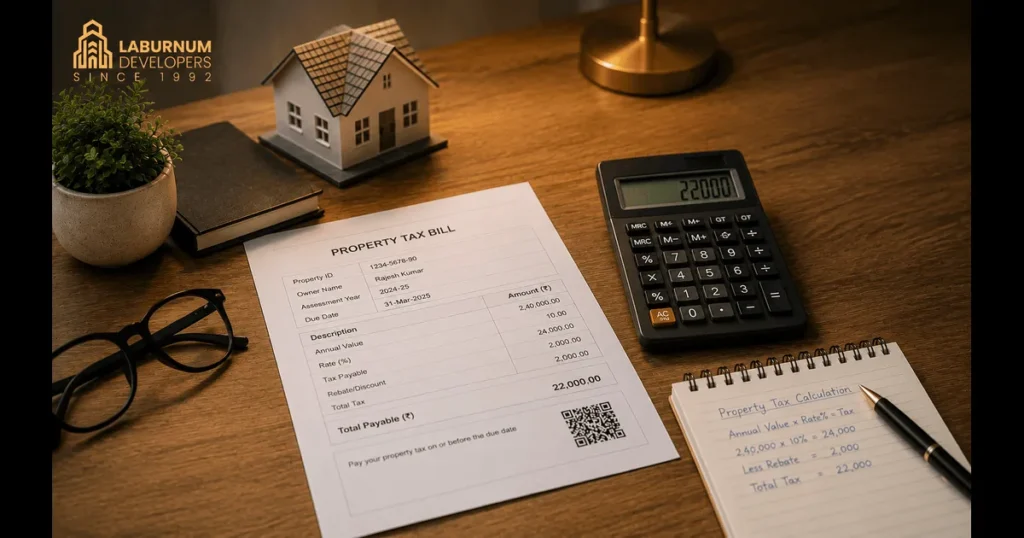
A Real Calculation Example for a Gurgaon Property
Let us take a real example. Suppose you own a 1,600 sq. ft. builder floor in Sector 63A, Gurgaon.
Step 1 – Let’s start with finding the base rate in your area. The Municipal Corporation of Gurugram (MCG) defines the sectors into different zones. For Sector 63A, it belongs to a premium zone, and the base rate there is around 1,000 per sq. Ft per year.
Step 2 – Consider your usage factors. For self-occupied residential use, this is 0.8.
Step 3– Now take the age factor. Since my apartment is less than 5 years old, I’ll be taking 1.0.
Step 4– This is all it takes; we just need to put these figures into the formula: 1,600 × 1,000 × 0.8 × 1.0 = 12,80,000 (Annual Rental Value).
Tax Rate from MCG: ≈ 6%. So the total annual property tax is: 12,80,000 × 6% = 76,800.
That translates to approximately ₹6,400 per month. This is a rough example — actual MCG calculations use more specific zone rates. Always verify your exact zone rate at the MCG portal (mcg.gov.in).
Property Tax in India State-wise: Key Rates and Portals for 2026
Property tax rates differ significantly across Indian states. Here is a practical reference for major cities.
| State / City | Municipal Body | Method | Approx. Residential Rate | Payment Portal |
| Delhi | MCD / NDMC / SDMC | Unit Area Value | 6–12% of ARV | mcdonline. nic. in |
| Mumbai | BMC | Capital Value | 0.316–1.072% of Market Value | portal.mcgm.gov.in |
| Bengaluru | BBMP | Unit Area Value | 0.1–0.6% of Guidance Value | bbmp.gov.in |
| Hyderabad | GHMC | Unit Area Value | 15–30% of ARV | ghmc.gov.in |
| Chennai | GCC | Annual Rental Value | 5–10% of ARV | chennaicorporation.gov.in |
| Gurgaon | MCG | Unit Area Value | 6–10% of Annual Value | mcg.gov.in |
| Noida | Noida Authority | Area-based | 1–2% of Allotment Value | noidaauthorityonline.in |
| Pune | PMC | Capital Value | 0.2–0.4% of Ready Reckoner | pmc.gov.in |
| Ahmedabad | AMC | Unit Area Value | 15–30% of ARV | ahmedabadcity.gov.in |
| Kolkata | KMC | Annual Rental Value | 5–25% of ARV | kmcgov. in |
A quick note on rates: the prices indicated above are based on the average domestic rates per city and given as an indication of cost only, so they might vary based on the zone you are in, the age of the building you live in, the floor of your home, and the type of service you request.
Property Tax in Gurgaon (Haryana): What Builder Floor Owners Pay
So many customers inquiring about properties by Laburnum Developers in Gurgaon ask about property tax. So here’s a dedicated rundown for Gurugram.
- MCG – Municipal Corporation of Gurugram
- Basis of taxation is – Unit Area Value System
- Rate of tax – Roughly 6% of the Annual Value of your house.
MCG categorises the entire city of Gurgaon broadly into three zones on the basis of locality & development.
- Zone A premium) – DLF, Golf Course Road & Extension, DLF 65, Golf Course Road eExtension(sectors 63A, 65), Sushant Lok. Per sq ft, the base rate is high.
- Zone B(mid-premium) – Newer areas such as Sectors 82A, 83, 88A, 89 New Gurgaon etc… The rate is medium.
- Zone C(developing) – Peripheral sectors with the lowest rates.
For example, Property tax on a 1600 sq ft builder floor for a house in zone B
Sector(say 88 A or 89) would be between 15,000 and 35,000 annually.
Interestingly, 10% discount if you pay property tax in Haryana before the deadline (June 30th every year). Also, a woman owner of a property in some municipal zones also gets an added rebate.
Pay Property Tax Online in Gurgaon:
- Visit www.mcg.gov.in (search for Property Tax)
- Key in your property ID and see the calculation
- Pay the amount through UPI, net banking, or Debit Card.

Who Is Exempt From Property Tax in India?
Several categories of property owners either get a full exemption or significant reductions. Here is who qualifies.
Full exemptions (in most states):
- Land that’s being used only to cultivate crops
- Land that’s in the possession of a religious trust or a registered charitable trust
- Land possessed by a university or a school that is being used as academic property. (Note: Certain properties under the government do come with the liability to pay service charges)
- Properties that are less than a threshold (usually 100 sq. ft. in case of residential homes in cities, but this may vary from city to city)
Partial exemptions or rebates:
- Senior citizens (above 60 or 65, depending on city) — typically 10–30% rebate
- Ex-servicemen and war widows — full or significant exemption in many states
- Differently-abled property owners — a rebate of 25–50% in most cities
- Women’s sole-ownership properties — rebate in several cities, including Delhi and Gurgaon
- Historic / heritage buildings — reduced rates to encourage preservation
- Low-income housing (EWS/LIG category) — often below the minimum threshold or exempt
Additionally, many cities offer early payment discounts. For example:
- Delhi MCD: 15% rebate for online payment before due date
- Gurgaon MCG: 10% rebate for payment by June 30
- Bengaluru BBMP: 5% rebate for full-year payment in April
So keep your property tax paid on time always. It’s no myth that you end up saving big money. The rates of property tax in India differ considerably across states.
For instance, rates set by Delhi’s MCD, Mumbai’s BMC, or Gurgaon’s MCG differ.
Further, to calculate your property tax in India, you have to focus on where the property is located.
Consequences of Not Paying Property Tax in India
There are many property owners who will delay payment of their property tax or avoid paying it altogether, thinking there is no immediate impact. That’s a costly assumption.
If you fail to pay on time:
Late payment interest: Most cities have a late payment interest rate of 1–2% a month on the unpaid balance. So, if you do not pay the tax worth of ₹20,000 per year, you will have to pay ₹24,000 to ₹28,000 annually in a year.
Penalty charges: There is also a flat charge for the city, as well as interest.
Sealing or attachment of the property: The municipal corporation can seal or attach the property if the tax has not been paid for some years. This is only a last resort, but it does occur in large cities in India.
Cannot sell the property: When you sell a property, the buyer’s lawyer checks for any outstanding dues, including property taxes. If there are any amounts due, these should be settled before registration. Thus, if you pay off your property tax without making any payments, you will not be able to sell your property.
Home loan complications: Banks will verify property tax standing before processing home loans, and occasionally at the annual review. Arrears may make the loan sanction/renewal process more complex.
To sum up, pay your bills on time. In most cities, you can get the early payment discount, and therefore, you can save money by paying early rather than incurring a penalty.
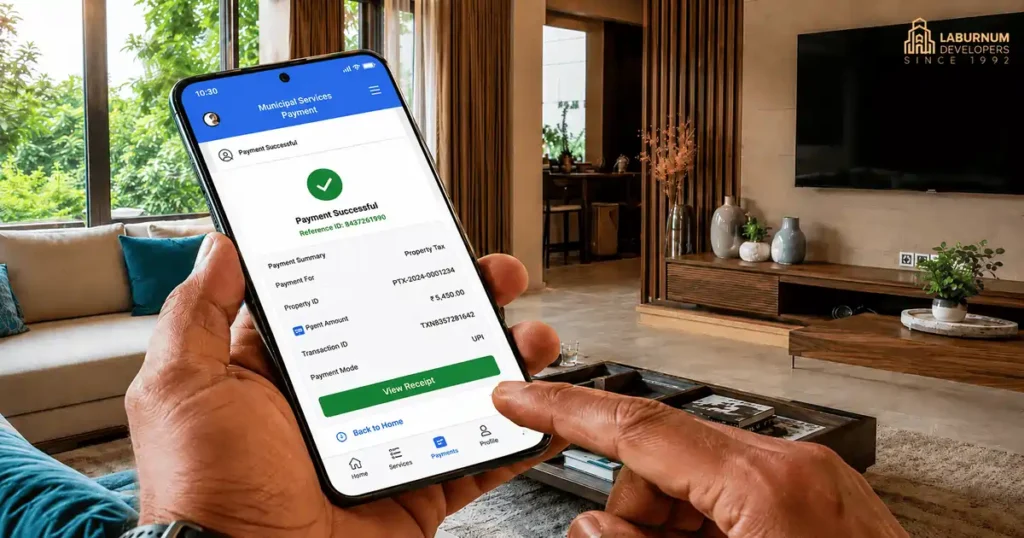
How to Pay Property Tax Online in India: Step-by-Step
Paying property tax online takes less than 10 minutes in most cities. Here is the standard process.
Step 1 — Find your property identification number. Your property ID is mentioned on previous tax bills, in your municipal registration documents, or on the municipality’s portal if your property is already registered.
Step 2 — Visit your city’s official portal. Use only the official government website.
Step 3 — Enter your property details. Input the property ID or owner name and address. The portal will display your property details, current year’s tax due, and any pending arrears.
Step 4 — Verify the calculation. Check that the property area, zone, and use type are correctly recorded. If there is a discrepancy, contact the municipal office before paying; overpaying because of an incorrect record is common and difficult to refund later.
Step 5 — Choose your payment method. Most portals accept: UPI (Google Pay, PhonePe, Paytm), Net Banking, Credit or Debit Card, NEFT/RTGS for larger amounts.
Step 6 — Download and save your receipt. After payment, download the payment receipt immediately. Save a digital copy. Furthermore, file the original receipt physically — you may need it for property sale registration, home loan applications, or future dispute resolution.
Property Tax and Real Estate Investment: What Buyers Must Know
Property tax is an ongoing expense to consider when you invest in an apartment, builder floor, or a plot, and must be included in your property investment calculations.
For buyers, what counts is:
Your property tax is a component of your cost of ownership. The annual property tax for a property worth ₹3 crore in Gurgaon is estimated to range from ₹25,000 to ₹60,000, based on zone and size. Over 20 years, that is ₹5–12 lakh. Consider this when making your investment model.
Before purchasing, check for overdue payments. From the date of registration, any outstanding property tax owed for a property will be your responsibility. Insist on a no-due certificate from the municipal body before completing any property purchase.
Who’s getting the money from the builder for a floor or apartment? Each property owner pays their own property tax to the MCG on a builder floor. For an apartment society, property tax is collected by the RWA as part of the maintenance, and the money is paid as a collective of the apartment society. Check with your developer before buying.
Rental yield is impacted by property tax. When working out the net rental yield of an investment property, deduct the annual property tax from the gross rental income. If your property is giving a rent of ₹60,000 per month (₹7.2 lakh per year) and the property tax is ₹40,000 per year, your net rental income is ₹6.8 lakh per year.
Whether buying a property or building a house with us at Laburnum Developers, we give buyers a comprehensive cost of ownership breakdown for every development we have, with estimated annual property tax calculated by zone, size, and current MCG rates. We’re currently working on the following projects:
Victory Floors Sector 63A – 3 BHK + Study, ready to move, from ₹2.80 Cr.
Victory Floors Sector 88A — 4 BHK, 2,043–3,150 sq.ft, from ₹3 Cr
Victory Floors Sector 89 — 4 BHK, 1,647–4,770 sq.ft, from ₹2.35 Cr
Laburnum Homes Sector 82A — 3 BHK, 1,080–1,600 sq.ft, from ₹1.70 Cr

Property Tax vs House Tax in India: Are They the Same?
These terms are often used interchangeably and, though similar, are two different concepts. Here is the clear answer.
In effect, property tax and house tax are interchangeable. They are both used for the annual tax levied by a municipality on real property.
Some municipalities, however, refer to “house tax” for residential tax and “property tax” for commercial and industrial properties. This is not the case elsewhere in the world, and the names are used in an interchangeable manner in other cities.
Furthermore, Property Tax is not the same as Stamp Duty and Registration Charges. Stamp duty is a lump sum that’s paid when purchasing a property. Property tax is a fixed amount of money paid on a property annually that you will be paying for the entire ownership.
It is also not the same as the capital gains tax that you would be charged if you happen to sell a property at a profit.
Simply put, property tax, house tax, and municipal tax are pretty much the same. The stamp duty, registration fees, and capital gains tax are independent taxes with different bases.
Smart Tips to Reduce Your Property Tax Legally
Now, property tax isn’t something that you can, or necessarily even want to, evade. There are, however, ways of reducing the load.
1. Double-check the zone classification
There are instances when municipalities might just be assigning your property to a zone class that is higher than deserved. So, if you are a property that lies on the border of two zones, ensure you’ve got the right zoning done. A zone correction may go a long way in getting a lower bill.
2. Get an age deduction claim
Most cities these days grant age-factor benefits to buildings that are 15–25 years old or older. If you fit into this category, make sure that the age factor is attributed to your building properly.
3. Apply for senior citizen/disability rebate (if eligible)
Most often, entitled property owners miss out on a lot of these rebates as they don’t know such rebates exist! Find out more about them on your municipal website.
4. Pay on time and online!
Many cities have a 5%–15% rebate for paying early, and when you’re paying online, there’s often another rebate offered. So, not only does paying early get you some benefit, but paying online will help even more!
5. Verify your Area
You might be paying property tax on a higher built-up area than what is accurately reflected in your property records. Get these corrected from the municipal records for an immediate tax reduction.
6. Get an exemption if the building is new!
Some municipal corporations offer tax exemption on a newly built property for the first year. While this may vary from municipality to municipality, it is worth enquiring with your builder or directly with the MCG.
FAQs: Property Tax in India, State-Wise Rates & How to Calculate
Q. What is property tax in India, and who collects it?
In India, property tax is essentially a yearly fee imposed on your real estate holdings. Local governing authorities such as Municipal Corporations (in cities), Municipal Councils (in small towns), and Gram Panchayats (in villages) collect these dues. These are levied on residential buildings, commercial properties, and plots of unused land.
Such funds are then utilised for providing and maintaining civic amenities such as roads, streetlights, drainage, and waste disposal.
The central and state governments don’t charge property tax themselves.
Q. How is property tax calculated in India?
Now, the way property tax is calculated varies across different cities—primarily, there are three main methodologies! Chennai, for instance, has an ARV or Annual Rental Value system where tax is calculated on an estimated annual rent of the property. Mumbai, on the other hand, has a Capital Value system that relies on the market value of the property for taxation.
And in Delhi, Gurgaon, Bengaluru, and Hyderabad, there’s a Unit Area Value system that involves multiplying per sq ft rates of a given area by the built-up area and the use of the property.
However, in each of these methods, the basic value is multiplied by the relevant tax rate to arrive at the annual property tax.
Q. What is the property tax rate in Gurgaon for a residential property?
The Municipal Corporation (MCG) follows a Unit Area Value System and applies an approximate 6% on the annual value of property assessed. But that’s not it; every sector has its own base rate depending on its position in the city. A developed zone such as Sector 63A will demand higher charges than the underdeveloped ones such as Sector 82A or 89.
If one lives in a Zone B area, then one would have to pay 15,000 to 35,000 a year (for a 1,600sqft residential builder floor) as yearly property tax.
However, in MCG, you can get a 10% tax discount if you pay it before the 30th of June.
Q. What is the penalty for not paying property tax in India?
Property tax default invites an interest rate of 1% or 2% monthly in most cities, whereas some have a one-time penalty. Property can be locked or even mortgaged by a municipal corporation if property tax defaults are for a few years. An unpaid amount has to be settled for any property to be sold as a registered sale deed.
Q. Who is exempt from property tax in India?
In most of the cases, exemptions are provided for central and state government-owned premises, registered charitable/religious trusts, farmland used for agriculture, and plots falling under a minimum area limit. In some cases, rebates or some exemptions can be provided for war heroes and widows, senior citizens (in most of the cities, 10%-30 %), persons with disabilities, ty and women-owned houses. Discounts for paying bills before the last date, which generally range from 5%–15%, are also given for paying the bills in advance by people residing in large cities.
Q. How do I pay property tax online in Gurgaon?
Head on over to the MCG website (mcg.gov.in). Navigate to Property Tax and punch in your Property ID to check the calculated tax. Now pay the amount via UPI (Google Pay, Paytm, PhonePe), Net Banking, or Credit/Debit card.
Be sure to download and save the receipt right after that!
MCG offers a 10% rebate if you pay the tax before the 30th of June.
Q. Is property tax the same as house tax in India?
Technically speaking. Property tax, or house tax, is the annual tax that municipalities impose on the ownership of property. In certain cities, it may be labelled a house tax when it is levied on a residential building and a property tax when levied on a commercial building, but the idea is the same for all. They’re also not to be mistaken for stamp duty (a charge levied only once at the time of purchase), registration fee, or capital gains tax (a charge on profits arising from the sale of a property).
Q. Does property tax apply to builder floors in Gurgaon?
Yes, property tax applies to all residential buildings, including builder floors. Owners of each floor in a Stilt + 4 building pay their property tax separately to MCG. It’s charged on each floor individually. Buyers should look for any unpaid property tax dues on the floor before they purchase it, since outstanding amounts move on to the buyer.
Final Word: Property Tax in India Is Manageable When You Understand It
As long as you know how to understand the property tax in India, it is not a burden.
Most of the Indian homeowners shell out a whole load of money or go for rebates due to a lack of time to understand the system. It can save thousands of rupees annually to invest one hour in understanding your municipality, zone classification, and applicable exemptions.
Also, if you are a property buyer or investor, you cannot properly calculate the return on your investment unless you consider annual property taxes.
When considering a Laburnum Developers project in Gurgaon, our team is capable of giving you complete transparency with the estimated property tax amounting to the property, depending on the zone rates of MCG for the respective sectors in which we construct our projects.



Comments are closed