




RERA is the most vital real estate law after independence in India. It was introduced in May 2017. RERA safeguards home buyers by ensuring projects are registered, deadlines are a fixed timeline, pricing is in carpet area terms, escrow funds are kept on a 70% retainage, and there is a dispute resolution period of 120 days. It brought a degree of regulation to the real estate sector in India and made it one of the most regulated in Asia.
That is the short answer.
Now let’s dive deep into every benefit in detail — If you are purchasing a home in India, you need to understand all the benefits RERA provides to you.
What Is RERA? A Simple Explanation
RERA is an acronym for the Real Estate (Regulation and Development) Act, 2016.
It was passed by Parliament in March 2016. It was fully operational in May 2017. The Act established regulatory bodies at the State level in India, known as Real Estate Regulatory Authorities (RERAs).
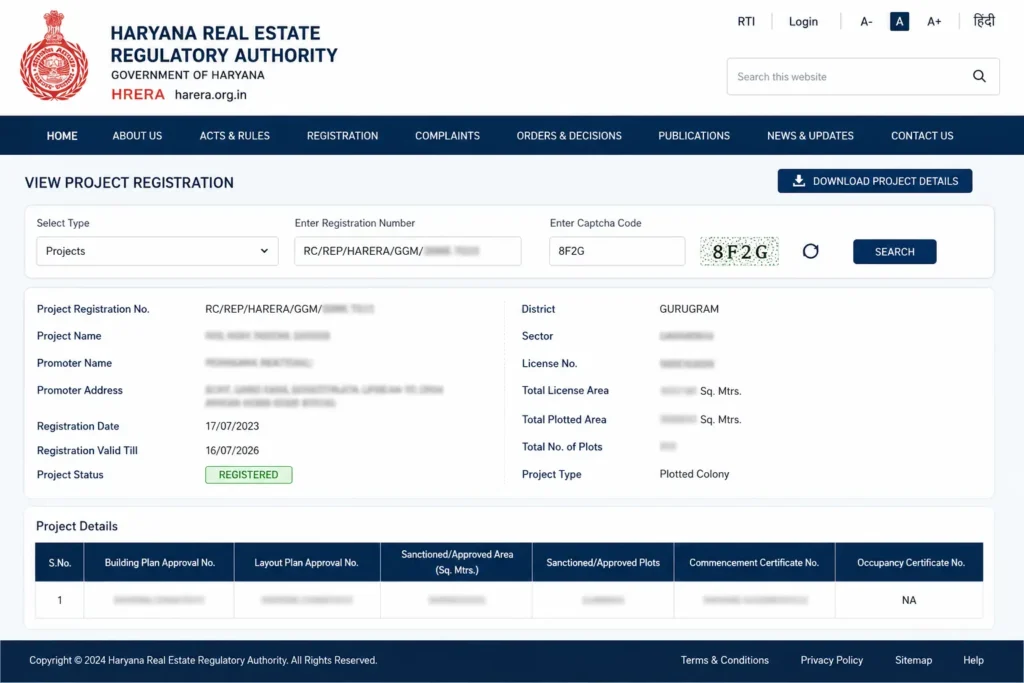
In Haryana, the authority is called HRERA (Haryana Real Estate Regulatory Authority). Buyers purchasing property in Gurgaon verify project registration at hrera.org.in.
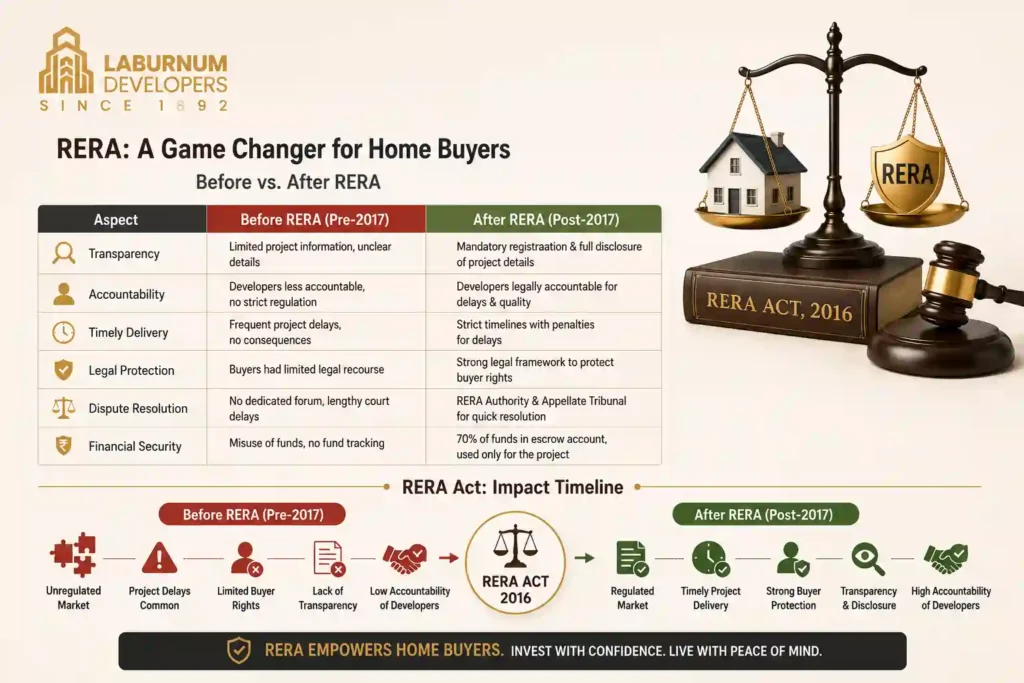
Prior to RERA ACT, the Indian real estate industry was mainly informal. Builders establish their own guidelines. Timelines were suggestions, not commitments. Pricing was opaque. When everything went wrong, buyers had virtually no means of redress.
RERA changed that. It established a system that encourages the registration and disclosure of information about their projects publicly, requires escrow accounts for builders and penalizes builders who break terms and conditions.
In short, RERA transferred the power from the developers to buyers. Additionally, it did so in the name of the law, not simply good intentions.
Why India Needed RERA: The Problem It Solved
For a better understanding of the benefits of RERA, it is best to look at what buyers were dealing with prior to 2017.
There was a large number of cases with indefinite delay. Builders guaranteed in three years. Deliveries were delayed for six, seven or eight years. People who bought homes have made EMIs for loans they did not use to buy. No penalties for the game.
Confused pricing was by design. These builders promoted properties under the banner of “super built up area” which included lobbies, lifts, staircases and even external walls. The customers paid for space that they did not occupy. The true square footage (also known as the carpet area) was not often revealed at the outset.
Fund diversion happened openly. The builders raided funds from one project that had been purchased to finance another project. If projects do not succeed, investors lose their investments, in many cases without legal recourse.
Mis-selling was rampant. Swimming pools, green parks and clubhouses – all of which were never realized – were displayed in brochures. There were no legal obligations on verbal promises.
Dispute resolution was painfully slow. The dispute resolution process was cumbersome and tedious. There were pending cases in consumer courts. It took years for buyers to get a verdict and it proved as difficult to enforce as well.
All of these issues were solved by RERA. Moreover, it did so with legally enforceable penalties, rather than guidelines.

8 Key RERA Act Benefits for Home Buyers in India
Below are the Top 8 benefits of RERA — simple, easy-to-understand explanations of what they actually mean to you.
Benefit 1: Mandatory Project Registration Creates Accountability
The RERA Act requires pre-launch of all real estate projects of a particular size to be registered with the state authority.
In general, any project that has a plot size exceeding 500 sq.mt and/or more than 8 apartments, has to be registered. The builder is required to offer:
- Land ownership documents
- Sanctioned layout plan
- All necessary approvals will be obtained.
- Projected timeline for completion
- Each of the ongoing litigations shall be disclosed.
As a buyer, you can view complete details of any RERA-registered project from the RERA website in the state in which you are buying the project. Before paying a single rupee, you are aware of the legal status of land, approved design, and the builder’s track record.
Moreover, agents and brokers need to register with RERA as well. Only registered agents can sell RERA registered projects.
Benefit 2: The 70% Escrow Rule Protects Your Money
This is likely to be the most effective financial safeguard under the RERA Act.
The law stipulates that builders place 70% of money paid from buyers in an escrow account. Only the construction costs and land payments for the project can be made with this money. It is not transferrable to other projects.
Why this matters: Builders used to have the power to siphon funds from the Project A buyers for the financing of Project B and/or to pay the debt to others prior to RERA. Here, buyers were stuck as Project A came to a standstill. Structurally, this is a rule that cannot be overcome with the 70%.
Additionally, the withdrawal from an escrow account is to be certified by an engineer, architect and chartered accountant. As a result of this triple verification, diversion is very rare.
Real impact: Buyers in the RERA-registered projects have lesser risk of the developer going out of the way in the middle.
Benefit 3: Fixed Timelines With Penalty for Delay
Possession dates for builder contracts were wishful thinking before RERA. The safety of the buildings was not jeopardized and builders could wait indefinitely without significant consequences.
The whole scenario changed when RERA came into existence. The builders have to specify a possession date in their RERA registration. If they miss this date, the buyer will have two choices:
- Withdraw from the project and receive a full refund with interest (at SBI’s lending rate + 2%)
- Continue and receive compensation for every month of delay at the same interest rate
What this means practically: If your builder has been 18 months late on a ₹2 crore apartment, you should get compensation of around ₹3–4 lakh per year, or a full refund with interest if you want to walk away.
As a result, builders now have an actual monetary reason to be on schedule.
Benefit 4: Carpet Area Pricing Eliminates Confusion
This is a benefit that directly impacts payment, and the amount of space you actually get.
Prior to RERA, most builders used to fix the rate for the property according to the concept of “super built up area” which meant that it comprised:
- Common lobbies and passages
- Lift shafts and stairwells
- Exterior wall thickness
- Proportional share of the parking and amenity area.
The typical transaction consisted of a buyer paying for 1,400 sq.ft on paper and getting 900-1000 sq.ft of living space.
Priced on carpet area is the new requirement in RERA. The RERA Act provides a clear definition of carpet area, which refers to the area within the walls but excludes balconies, service areas, common areas etc.
Furthermore, if the builder provides less carpet area than is specified in the contract, the buyer should be given a corresponding refund.
For Gurgaon buyers specifically: The carpet area benefit is even greater for Gurgaon buyers compared to apartments when they purchase a builder floor in Gurgaon. There is considerably less common area for builder floors. Hence, the difference between carpet area and total area is not very high — 10-15% as compared to 25-35% for high-rise apartments.
Benefit 5: Right to Information — Full Disclosure is Now Mandatory
RERA provides all the buyers with the legal right to access all information related to the project both before and after purchasing.
Every project should have a fresh RERA portal page that is maintained by the builders. This page should contain the following:
- Development plans and layouts as drawn by the architect
- Any changes to approved plans (changes must be made public)
- An updated list of all regulatory approvals.
- Schedule of completion
- Documents relating to land title
- Quarterly progress reports with photographs
What this means in practice: YYou can keep checking your project’s status on the official RERA website, not relying on your builder’s marketing team. Also, if changes are made to the design after you book (such as change to smaller units or remove the clubhouse) they have to let you know and get your permission.
If more than two-thirds of buyers are affected by the change, it must have the approval of two-thirds of the buyers by a majority vote. This will prevent any builders from quietly lowering a project once they have received the majority of the funds.
Benefit 6: Fast Dispute Resolution Within 120 Days
The predicament of buyers was not hassle-free before RERA as they used to suffer a frustrating wait in case of complaints against builders. Consumer forums were jammed packed. Cases were protracted and lasted many years. Enforcement following judgment was another fight.
The RERA Act established a streamlined and quick dispute resolution system. Each state RERA has its adjudicating officers and appellate tribunals dedicated to real estate disputes.
It is legally bound that within 60 days the adjudicating officer shall resolve the disputes and within 60 days more from the date of the resolution, the disputes shall be resolved by the RERA appellate tribunal. Thus, the overall maximum time allowed for the first appeal is 120 days.
What this means for buyers: You are granted a court dedicated to your property dispute. It is quicker and easier than the general consumer forum. Additionally, the judges only hear real estate cases, giving them the knowledge and expertise of the technical and legal aspects of the industry.
If the builder defies the orders of RERA, he can be penalized up to 10% of the estimated cost of the project. Penalties include up to three years’ imprisonment for continued violations. These are real, not symbolic, deterrents.
Benefit 7: Standardised Sale Agreements to Protect Buyers
Before RERA Act, builders were drawing up their own sale agreements. Such contracts were normally drawn up in favour of the builder, rather than the purchaser.
Builders’ preferred termination clauses were in effect. Early buyers were refunded, but had big deductions. Little punishment was meted out to builders who were late.
RERA standardised this. The model sales contract format is provided in the Act. States have adapted this template, but the basic protections are the same:
- Equal penalty during default, for buyer and builder.
- Charges must be disclosed on all disclosures provided in the sale.
- Explicit possession date with compulsory obligation to pay the penalty.
- Buyer’s right to access the project during construction
- Warranty for construction defects for 5 years after possession.
Additionally, any provision of a builder’s sale agreement that is contrary to RERA Act shall be of no force and effect. Don’t try to negotiate these protections, they are there by law.
Benefit 8: Five-Year Structural Defect Warranty
Once the possession, if any damage occurs in the structure, the complainant can file a complaint within 5 years with RERA Act.
Defects are to be rectified free of charge by the builder within 30 days of receipt of the complaint. If they don’t correct it, you deserve compensation.
What counts as a structural defect? Inability to waterproof, failure of materials or workmanship in the construction of the building, such as cracks in walls, seepage, plumbing, electrical defects.
This warranty applies to all buyers in RERA-registered projects. Furthermore, it runs from the date of possession — not the date of booking. Therefore, even if possession was delayed, the full five years starts fresh when you actually get the keys.
RERA vs Before RERA: A Direct Comparison
| Factor | Before RERA | After RERA (2017–2026) |
|---|---|---|
| Project registration | Optional | Mandatory |
| Pricing basis | Super built-up area | Carpet area only |
| Possession timeline | No binding commitment | Legally binding date |
| Fund utilisation | No restriction | 70% in escrow account |
| Design changes | Builder’s discretion | 2/3 buyer consent needed |
| Dispute resolution | Consumer forums (years) | RERA tribunals (120 days) |
| Agent accountability | Unregulated | Mandatory RERA registration |
| Structural warranty | No standard | 5 years after possession |
| Advertising rules | No restriction | Only post-registration |
| Penalty for delay | None / minimal | Interest + refund option |
As you can imagine, RERA revolutionized the entire buyer/builder relationship. In addition, it did so via a legal mandate, not via industry self-regulation.
How RERA Act Works in Haryana: What Gurgaon Buyers Need to Know
The Haryana Real Estate Regulatory Authority (HRERA) is the authority that is responsible for implementing the RERA in Haryana. HRERA currently has 2 benches – one at Gurugram and another at Panchkula.
For any project in Gurgaon, Before booking any project in Gurgaon always check its HRERA registration at hrera.org.in before buying any project.
Below are the items you will see on the HRERA website:
- Registration status: Active or lapsed — Active or lapsed — an active registration implies that the builder is compliant
- Possession date: The possession date as recorded on HRERA is the statutory date.
- Complaints filed: Any complaints in progress against the builder or project are displayed here.
- Escrow account details: Verification that 70% of funds are being kept.
Furthermore, HRERA also has its own penalty and enforcement mechanism exclusive to the state of Haryana. HRERA orders will be enforced on builders who breach them. ICRC orders are subjected to penalties as per the specific implementation of RERA Act by HRERA.
At Laburnum Developers, We ensure that HRERA compliance is maintained throughout all projects with a qualifying status. Buyers are advised to check each project on HRERA portal independently. Furthermore, we proactively supply all documents related to DTCP and HRERA to the buyer and not only upon request.
How to Check RERA Compliance Before Buying a Property
Here is a practical, step-by-step process every buyer should follow.
Step 1 — Visit the state RERA portal. Go to the state RERA portal. There are portals for each state and they are haryanarera.gov.in for Haryana, for Delhi and maharera.mahaonline.gov.in for Maharashtra. Use the one that’s relevant to where you are purchasing from.
Step 2 — Search by project name or registration number. The developer should provide you with the RERA registration number prior to booking. That is a red flag if they’re unable to supply it.
Step 3 — Check the possession date. Record HRERA registration date of possession. This is the official agreement that is in force. If there is any difference from the salesperson’s information, believe the RERA portal.
Step 4 — Check for existing complaints. If the complaints are already filed by the buyers against the project or the builder, then this will be reflected on the portal. If there are two or three complaints on one project, it needs to be looked into.
Step 5 — Verify escrow account maintenance. The portal displays whether or not the builder is complying with the 70% escrow requirement. A large gap here is one of the big red flags.
Step 6 — Confirm the agent’s registration. Please request your broker/agent’s RERA registration number. Also, check it on the same platform. The agents, who are not registered, are not legally qualified to sell RERA-registered projects in Haryana.
Step 7 — Cross-check DTCP approval for builder floors. Make sure builder floors have DTCP approval. As far as the low-rise builder floors in Gurgaon are concerned, also the building plan approved by DTCP is to be taken note of separately. There are two compliance systems – RERA and DTCP both are important.
Common Misconceptions About RERA
There are a lot of buyers out there who do not understand the scope of RERA and what it does not cover. The following are the most frequently held incorrect perceptions.
Misconception 1: All projects are automatically RERA-compliant. Not true. Registration is required for projects with more than the threshold (500 sq.mt plot or 8+ units). Smaller projects may not be needed to be registered under RERA. For them, the first lines of defense are DTCP approval and OC compliance.
Misconception 2: RERA registration means the project is safe. Once a project has been registered with RERA, then the project has fulfilled the documentation requirements. Does not guarantee completion or delivery. Validation of the builder’s track record should be carried out independently.
Misconception 3: RERA protects only apartments. Not true. RERA applies to all housing properties: Apartments, Builder floors, Plotted development and Commercial properties. Hence, all builder floor buyers in Gurgaon are also at the advantage of RERA.
Misconception 4: RERA disputes take as long as consumer courts. Not true. The time frame for adjudication is 60 days and the appeals are for an additional 60 days as per RERA. This is much quicker than conventional consumer forums.
Misconception 5: The 70% escrow rule covers your full investment. 70% escrow applies to your total investment. The escrow account includes the cost of construction, land, and other fees. The remaining 30% may be allocated to marketing, administration and other expenses. You don’t put all your money in the escrow. However, the 70% rule is still a significant protection.
RERA and Laburnum Developers: Our Commitment
Purchasing a home is one of the largest monetary choices you will make. Hence at Laburnum Developers we take RERA compliance as a basic requirement and not a differentiating feature.
All projects that meet the criteria are registered with HRERA. We have 70% escrow accounts, we make all the disclosures required under the HRERA on our portal, and we deliver possession dates that are in line with our registered commitments.
Furthermore, in critical areas we exceed the requirements of RERA:
- All projects are constructed based on DTCP approved building plans.
- Road width compliance with Stilt+4 construction is checked prior to construction.
- Occupancy Certificates are issued prior to offer of possession on a ready to move development.
- Every buyer is provided with complete documentation including Jamabandi, DTCP plan and OC proactively.
Currently available projects:
Our current projects span the Dwarka Expressway corridor and Golf Course Extension Road:
- Victory Floors Sector 63A — 3 BHK + Study, ready to move, from ₹2.80 Cr
- Victory Floors Sector 88A — 4 BHK, 2,043–3,150 sq.ft, from ₹3 Cr
- Victory Floors Sector 89 — 4 BHK, 1,647–4,770 sq.ft, sample apartment ready, from ₹2.35 Cr
- Laburnum Homes Sector 82A — 3 BHK, 1,080–1,600 sq.ft, from ₹1.70 Cr
Frequently Asked Questions: RERA Benefits for Home Buyers
Q. What is RERA and when did it got into the force in India?
RERA” is Real Estate (Regulation and Development) Act, 2016. It was passed by Parliament in March 2016. It became in operation in May 2017. The Act established Real Estate Regulatory Authorities at the state level in India to overhaul the real estate sector, safeguard home buyers, and enhance transparency and accountability in India’s real estate transactions. There is no common RERA, each state has a different one, in the case of Haryana the RERA is known as HRERA.
Q. How does RERA benefit home buyers?
The primary advantages of RERA for home buyers are: mandatory project registration before the registration process, the requirement to have 70% escrow accounts which prevents buyer funds from being diverted, pricing based on carpet area (as opposed to super built-up area, which is often confusing), possession dates protected by interest compensation in case of delay, and the right to receive full disclosure of project information prior to the sale, as well as the 120-day time limit for dispute resolution and the use of standardised sale agreements with identical penalty clauses.
Q. Is RERA registration mandatory for all real estate projects in India?
Yes, RERA Registration is required for the projects having more than 8 apartments or having plot area greater than 500 sq. mt. Smaller projects which fall short of these thresholds may not need RERA registration. For non-RERA projects however, buyers ought to check some other safeguards such as DTCP approved building plans, land title and compliance with the Occupancy Certificate.
Q. What is the 70% Escrow rule in RERA for the protection of the buyer?
As per the RERA Act, all money received by the builder from the buyers must be kept in a dedicated escrow account of the builder and shall be held there for 70% of the money. This amount of funds is only available to use in the project for which it is allocated, for construction and land. To get a withdrawal, it needs to be authorised by an engineer, architect and chartered accountant at the same time. This rule allowed for no fund diversion between projects – one of the biggest factors contributing to project delays and failures prior to RERA.
Q. If a project is delayed, what is the compensation that a buyer will receive on a project registered under RERA?
In case a registered possession date is not mentioned in the RERA registered project, the buyer can choose from the following alternatives. Refund your money with interest at SBI’s margin lending rate along with 2% per annum.Withdraw from the project and get a full refund with interest at the SBI’s lending margin rate plus 2% per annum. Secondly, purchase, and then pay monthly interest on the amount purchased, throughout the delay. The builder is not allowed to lower or waive this compensation as it is a statutory right under RERA Act.
Q. What is the procedure to find out whether the property is RERA registered or not in Gurgaon?
Check the official website of Haryana Real Estate Regulatory Authority (HERA). You can search by project name or RERA registration number (the builder will provide this). You can view the registration status on the project page, as well as the registered possession date, escrow account compliance, and any complaints against the project. Be sure to do this before any payment or signing of contracts.
Q. Are the Low Rise builder floor in Gurgaon covered under RERA?
Yes. RERA covers all residential real estate projects such as low rises built by the builders on the floors and as long as the project satisfies the threshold criteria (plot area greater than 500 sq.mt or units greater than 8). All the RERA protections are applicable to a qualifying builder floor project – escrow account, carpet area pricing, fixed possession date, and dispute resolution rights. Below threshold, for smaller ‘builder floor’ projects, the buyer’s protections are mainly DTCP compliance and the Occupancy Certificate verification.
Q. RERA vs DTCP Approval for Property in Gurgaon?
There are two different compliance systems called RERA and DTCP. DTCP approval is linked with the building plan, which means that arrangements in the building plan including the design of the building, number of floors, the width of the roads, setbacks etc. are approved by law and can be built in Gurgaon. RERA registration is linked to the commercial and financial details of the project – timelines, funds administration, rights of the buyers, and dispute resolution. Both DTCP sanctioned building plans and HRERA registration should be with a well-regulated project in Gurgaon.
RERA is the Buyer’s Best Friend
Purchasing property in India used to be a risky business before May 2017. You got from a builder, gave them a lot of money and assumed the best.
This was changed forever by RERA.
Now, the rewards of RERA for house buyers are genuine, binding and the penalties are effective in making builders adhere to the regulations. The 70% escrow policy safeguards your funds. The carpet area requirement helps you become aware of the product you are purchasing. If it doesn’t go well, you have a short window for 120 days to reach a resolution.
Moreover, RERA celebrates developers that act in a transparent manner. The RERA benefits for home buyers extend beyond legal protection – they build a professional and responsible market. Constructors who experience escrow accounts, deliver on time and provide information transparently are really getting a competitive benefit in this market.
The approach that we have taken at Laburnum Developers is these very principles, long before RERA made them a rule. We believe well-informed buyers make the best decisions. The happiest families are those that make the best decisions.



Carpet Area Vs Super Built-Up Area | Laburnum Developers
June 25, 2026 - 10:47 am[…] Read Also… Revolutionizing Real Estate: Impact & Benefits of RERA ACT […]
Benefits Of Living In Low-Rise Apartments In Gurugram - Laburnum Developers
June 25, 2026 - 1:11 pm[…] regulatory framework to this housing category. All legit low-rise projects in Gurugram now boast of RERA registration, a clean title deed, and precise calculation for carpet area – thereby making the purchase […]
Encumbrance Certificate: Complete Guide For Buyers 2026
June 26, 2026 - 7:51 am[…] Read Also… Revolutionizing Real Estate: Impact & Benefits of RERA ACT […]
How To Analyze Gurgaon Builder Floors That Sell Fast: Real Estate Investment
July 4, 2026 - 12:09 pm[…] the RERA-registered builder floor project provides you with increased transparency compared to the resale […]
Gurgaon Builder Floor Investment Guide 2026 | Laburnum
July 6, 2026 - 12:55 pm[…] for something 10 units and 500 square metres or more, then you must have the Haryana authority’s RERA registration to show-you should verify it on their official portal. For individual plots of less than 10 units […]
How To Evaluate Luxury Builder Floor Projects In Gurgaon
July 8, 2026 - 10:36 am[…] plan needs to be approved by the Department of Town and Country Planning (DTCP) before construction. This document […]