




Table of Contents
If you have been browsing for listings and have been asking around to see whether this is the right time for investing, then an investment in a Gurgaon builder floor in 2026 happens to be one of the best options you can opt for if you want to invest in the Gurgaon property market. Unlike an apartment where the money is pooled for amenities, elevators, and common spaces, in a builder floor, your money is tied in the land itself; and land is the best type of investment that you could make, as it is known to be scarce and incredibly secure around the whole of NCR.
And land in Gurgaon has historically been the scarcest, most defensible asset in the entire NCR region. This guide walks you through exactly how to evaluate low-rise builder floors, which micro-markets are actually worth your attention this year, what drives real appreciation, and how to separate a ready-to-move home that’s genuinely valuable from one that just looks good in photos.
We’ll keep this practical. No brochure language, no inflated promises – just the framework serious buyers and investors use before they sign anything.
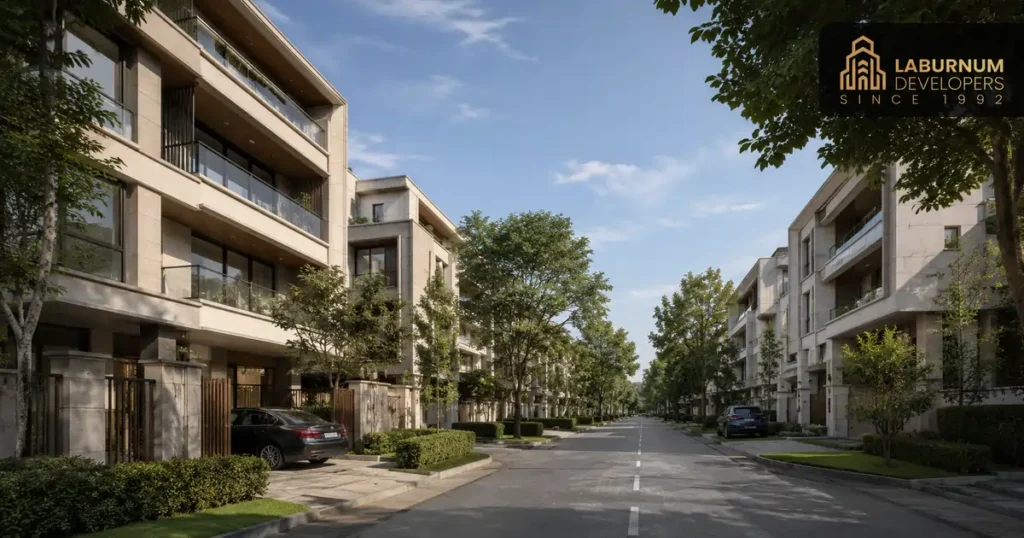
Why Gurgaon Builder Floor Investment Is Gaining Momentum in 2026
Gurgaon’s real estate narratives have been rewritten. From the hyper-speculative, anything-sells climate of the mid-2010s to the pandemic-reshaped era where real end-users and an increasing cadre of corporate employees call the shots. The significant takeaway for a new buyer? Less of the wild price swings which could often leave first-time investors blindsided.
In this more measured market, builder floors serve an interesting sweet spot. They offer the combination that discerning buyers often desire – an independent home that comes with the inherent perks of private ownership and land at a price that’s generally more attainable than that of a whole plot or a villa. Now, coupled with a more stringent regulatory landscape, with the Haryana Real Estate Regulatory Authority having increased the depth of scrutiny in its project approvals, it’s become a space where adherence to quality and the clarity of documentation are paramount-and if you’re savy about the due diligence, this actually plays to your advantage.
It is also important to be aware of the demand-supply dynamics. With recently altered floor-construction rules in several Gurgaon sectors restricting the number of additional stilt-plus floors one can raise on existing plots, there’s a reduction in new unit inventory against a more or less consistent or growing demand. This typically helps in sustaining or increasing property prices in existing pockets, especially those that already enjoy high resale liquidity.
What Makes Low-Rise Builder Floors Different From Apartments
A builder floor is an independent residential unit constructed on a plotted development, where each floor typically has a single owner rather than dozens of flats stacked into one tower. This single distinction cascades into almost every other difference:
- Density and privacy. Fewer households sharing a plot means fewer shared walls, less noise, and more control over your immediate environment.
- Land-linked value. A meaningful share of a builder floor’s price – often 60-70% in premium belts – reflects the underlying land, not just the construction. Apartments, by contrast, derive more of their value from amenities, branding, and the developer’s premium.
- Maintenance. Builder floors generally carry lower recurring maintenance costs than amenity-heavy apartment complexes.
- Resale behaviour. Apartments in supply-heavy corridors tend to resell faster because units are standardised and easier to compare. Builder floor resale is more selective – driven heavily by builder credibility, sector maturity, and whether the plot sits in a land-scarce zone.
There is no such thing as a “correct” choice. The choice depends on whether your goal is the rental yield and quick flip that is favoured by apartments, or long-term wealth preservation and land-based growth, which favours builder floors.

Gurgaon Real Estate Micro-Markets Worth Watching in 2026
Sector-wise, not everything is performing in the same manner, and this is what is the biggest pitfall where first-time buyers falter as they pin on one “hot” location, ignoring the alternatives. Here’s how the best micro markets compare for a builder floor buy this year.
DLF Phases 1-5 and Golf Course Road
This is still the Gold Standard on the Land Driven Indexation Index. Land values in such a fully built-up and tree-lined sector, in the presence of Schools & Hospitals, in proximity to the Gurgaon Business Hub, with Higher ticket sizes, the floor under your investment is the highest in India due to the structural land scarcity factor of these fully built-up regions.
Golf Course Extension Road
This one is going to be a new premium corridor for years to come. Floor prices on this corridor have registered good single-digit annual appreciation lately on the back of better connectivity, consistent flow of professionals to the area as a better alternative to higher-rise apartments. It’s slightly below DLF in terms of current prices, but with good medium-term upside as infrastructure keeps catching up.
Sector 57, 63A, 65, and 67
This cluster offers a genuinely balanced proposition – mid-to-premium pricing with an active, transparent resale ecosystem. Builder floors here benefit from faster absorption cycles compared to newer, still-stabilising sectors, largely because buyers already trust the neighbourhood.
Sectors 82-92 and New Gurgaon
This one is going to be a new premium corridor for years to come. Floor prices on this corridor have registered single-digit annual appreciation lately on the back of better connectivity, consistent flow of professionals to the area as a better alternative to higher-rise apartments. It’s slightly below DLF in terms of current prices, but with good medium-term upside as infrastructure keeps catching up.
Dwarka Expressway Belt
An infrastructure-led growth story. With connectivity infrastructure along this corridor on the verge of being completed, builder floors along this segment are now being benchmarked against apartments based on price-per-square-foot, and are emerging at a healthy parity. Do a quick gut check before shortlisting any of these: always look at the government-notified circle rate for a locality and compare it with the actual market rate. Any significant deviation from either direction means more questioning, not less.
Builder Floor ROI: What Actually Drives Appreciation
Real estate appreciation isn’t random – it follows a fairly consistent set of drivers, and builder floors respond to a slightly different mix than apartments do.
- Land scarcity in the micro-market. Established, largely built-out sectors with little room for new supply tend to see steadier long-term appreciation because demand keeps chasing a fixed base of plots.
- Builder credibility and construction quality. Two builder floors with identical plot sizes can diverge sharply in resale value based on structural quality, finishing standards, and whether the builder has a track record of honouring specifications.
- Connectivity and infrastructure delivery. Metro extensions, expressway completions, and improved last-mile access consistently show up as inflection points in local price trends.
- Regulatory clarity. RERA-registered projects and DTCP-approved plots carry materially lower legal risk, which in turn supports smoother resale and better bank financing – both of which feed back into value.
- Configuration and floor-count policy. Recent restrictions on additional floor construction in several sectors have tightened new supply in some builder-floor clusters, which have historically supported pricing in the short-to-medium term for existing, approved stock.
- Rental demand from the corporate workforce. Sectors with strong tenant demand from mid-to-senior professionals tend to combine capital appreciation with a reasonable running yield, which makes the holding period far easier to justify financially.
For builders, floor Roi is all that matters, and investors try to find the lowest rate per square foot available. However, over the five-to-ten-year timeframe, builders’ floors yielding the best result were the ones where there is a defensible piece of land that falls in a segment that has a real end user.

Ready to Move Homes vs Under-Construction Builder Floors
This is one of the most consequential decisions in the entire process, and it deserves more thought than it usually gets.
Ready to move homes: Move with complete freedom and eliminate all construction-timeline risk. View the build quality firsthand, see the finishing quality for yourself, and – should you be a landlord – generate income right away. The market has been facing a real scarcity of ready stock in the most sought-after, land-starved areas in the past year, and that price differential continues to exist in the ready stock market.
Under-construction builder floors: Usually offered for sale via RERA-registered projects, under-construction builder floors have a lower entry cost and greater potential for capital gains between the time of booking and possession. The compromise is straightforward: you take the timeline and construction-quality risk until the construction has finished, which you cannot verify perfectly.
A rule of thumb: If you want income property to generate rent in 6-12 months, or if you just want to get rid of execution risk, then buy ready-to-move-in from a builder with a history of timely delivery. If your timeline is 4-5 years and you can absorb the construction risk at a better price, an RERA-registered under-construction project from a reliable developer can get you much higher returns.
How to Evaluate a Builder Floor Investment: A Step-by-Step Framework
Before you shortlist anything, run every option through this checklist:
1. Establish your goal first and foremost. Are you looking for the highest rental yield possible, capital growth over the longer term, or a principal place of residence with the bonus of investment gains? Each approach leads you to different locations and configurations of housing.
2. Check the builder’s record. Ask about their last two or three finished projects, not just the one being sold. Go visit a past project, if you can, and chat with the occupants.
3. Verify the required regulatory approvals. If you’re looking for something 10 units and 500 square metres or more, then you must have the Haryana authority’s RERA registration to show-you should verify it on their official portal. For individual plots of less than 10 units (and less than 500 square metres), clear plot papers along with the DTCP approval are crucial.
4. Comparison between market rate and circle rate – A substantial difference between these two will always require careful attention and inquiry before a Buyer/Tenant begins falling in love with the property.
5. Check structural specs, not just sales hype. Investigate structural design certificates, quality of plumbing and wiring installation, and the crucial independent power and water connection to the floor – the definitive indicator of an independent level.
6. Model your holding period accurately. Builder floors in established areas tend to pay investors who have a long holding horizon. If you anticipate that you will require funds in 2-3 years, include a provision that the resale of builder floors is less active than that of ready-made flats.
7. Get every commitment in writing. Verbal assurances about amenities, finishing specifications, or possession timelines mean nothing without a paper trail.
Rental Yield Expectations Across Gurgaon Micro-Markets
It might be that capital growth grabs the lion’s share of the attention, but it’s the rental yield that should cushion your holding period until capital growth can catch up. A quick rundown of yield expectations across the segment is typically like this:
- DLF Phases and Golf Course Road: High cost of entry means low running yield to cost. However, tenant demand from very senior corporates is consistent, and vacancies tend to be brief.
- Golf Course Extension Road and Sector 57: More evenly distributed rental yield and appreciation prospects, the preferred destination of many investors expecting both moderate monthly return and sustainable long-term growth.
- Sectors 82-92, New Gurgaon, and the Dwarka Expressway corridor: Typically have the best rental yields on paper due to a lower per-unit purchase price relative to size, but the demand can be less stable until development catches up with the supply of commercial/physical infrastructure.
Simply put, if cash flow is a more significant driver for you than long-term appreciation, target growth corridors. If, on the other hand, the driving objective is the preservation of capital and you are not looking at servicing the debt on purchase via rental income, then target the supply-constrained existing sector.
Financing and Tax Considerations Worth Planning For
Funding a builder floor has a few key differences compared to a similar unit in a condominium project, and it makes sense to factor these into your planning before committing to a unit. Loan-to-value and lender comfort. Banks and housing finance institutions are more comfortable lending on RERA-registered, DTCP-approved builder floor projects with proper titles.
Unauthorised independent plots may warrant lower loan-to-value ratios or greater checks, and you need to check this before finalising.
Stamp Duty and Registration.
Every property transaction in Haryana carries stamp duty and registration fees, which you must include in your budget – don’t treat these as ‘extras’ at the last moment, as they can significantly increase the entry price and therefore impact your actual rate of return. Holding period and capital gains. The tax treatment of any capital appreciation on a builder floor in India is linked to your holding period – short-term investors may want to account for this in their return projections.
Read Alsoo.. What are Stamp Duty & Registration Charges in Gurgaon? A Complete Guide Property Registration
Rental Income and Tenancy Taxation.
If the unit will be leased out, be certain about what tax deductions can be applied to rental income exceeding the set limit; this can materially alter the net yield. All of this isn’t meant to derail a well-thought-out acquisition, but rather part of forming a more realistic outlook on what your effective yield will be before signing.
Common Mistakes First-Time Buyers Make
- Chasing the lowest price per square foot without checking why it’s cheap – often it’s compromised structural quality or incomplete documentation.
- Skipping RERA and DTCP verification because the broker “seemed trustworthy.” Verify independently, every time.
- Ignoring resale liquidity in a sector before buying – a great deal today is only as good as your ability to exit it later.
- Underestimating the value of land-backed pricing and comparing a builder floor purely against apartment amenities, missing the more important long-term ownership story.
- Not budgeting for stamp duty and registration charges, which materially affect your real acquisition cost in Haryana.
Where Laburnum Fits Into This Picture
We designed our entire strategy to cover just the checklist you’ll see below – RERA-approved paperwork, no concealed clauses with pricing in the brochure, and concrete, checkable building specifications. We suggest that if you’re shopping around in Gurgaon’s many builder floor offerings, you move on to our comparison of builder floor prices and sector-specific suggestions for 2026 before we provide a close look at current inventories for Sale.
Builder Floor Investment Timeline: What to Expect at Each Stage
Knowing the typical time flow for buying a builder floor can assist you in planning your finances and managing your anticipation levels. This journey from shortlisted property to final possession generally looks like this:
Shortlisting 2-4 weeks ( Sector analysis pays dividends here ). Before even thinking about making any offer, you need to visit a minimum of 3 to 5 properties in a minimum of 2 to 3 different micromarkets.
This is true, even if you have got a sector that already gets your interest. Only comparing side by side will expose several nuances, such as building quality and effective design that you would miss seeing in only 1 or 2 viewings.
Step 2: Due Diligence and Legal Verifications (1-3 weeks).
This is typically the phase in which buyers cut corners, and also typically the one in which issues occur. Conduct a site verification with DTCP/RERA approvals on your own and ask for the seller/builder’s sale deed and title chain. Whenever possible, use a separate legal attorney, rather than just the paperwork from the builder.
Stage 3: Funding Approval (2-4 weeks).
Should you require a housing loan, secure in-principle sanction from your lender before picking up a unit, as opposed to after the booking. If not, you could well end up being rejected for funding as the banks are unwilling to finance projects built on lands that haven’t obtained due approval.
Stage 4: Payment Plan.
The plan to pay, especially for a ready-to-move-in builder floor, typically involves a simple lump-sum payment or a transaction from the bank. In the case of under-construction RERA-registered properties, payments are usually on the basis of progress in construction, so align this plan against actual construction timelines.
Stage 5: Registration and possession.
This should cover your stamp duty payment, registration of your property with the sub-registrar, and a last site visit before getting possession – this is essential, particularly for ready-to-move properties, to check if the actual finishes match what was promised in writing.
The trick here is realizing each of these is a milestone, not a stepping stone to simply checking a box to reach signed documents, and builders’ floors, in general, don’t make these typical mistakes.
Final Thoughts
A Gurgaon builder floor investment in 2026 is not about the basic health of the Gurgaon real estate market – those factors (corporate growth, infrastructure delivery) are pretty clear. It is about choosing the right micro-market, the right builder, and the right floor configuration for your purpose. Those buyers who view this as a systematic decision process (and not just a panic response to marketing buzz) typically make better decisions (appreciation-wise as well as mentally).
Frequently Asked Questions: Gurgaon Builder Floors
1. Is a builder floor a good investment in Gurgaon in 2026?
Yes, if selected wisely. Builder floors in the land-scarce established regions have consistently shown appreciation, and the very nature of the format is ownership-based, with the same being less dense, hence attractive for end-users and investors over the long term.
2. What is the difference between a builder floor and an apartment in Gurgaon?
An apartment, in other words, has many neighbors (usually several hundred) all living on the same plot; a builder floor, in contrast, may have as few as 3-4 others in the same plotted development on a plot. Building floors are, as one might expect, based on land value with more privacy, whereas an apartment has a tendency towards a wide range of amenities and quick resale.
3. Which Gurgaon micro-markets are best for builder floor investment right now?
DLF Phases 1-5 and Golf Course Road represent the top-of-the-shelf, land-driven appreciation, while Sectors 57, 63A, 65, and 67 come with a more reasonable mid-to-premium entry and great resale liquidity.
4. How much does a builder floor cost in Gurgaon in 2026?
The price varies greatly depending on the sector and specification. Prices on the growing corridor can start quite a lot cheaper at the entry-level spec, while premium builder floors on a DLF or Golf Course Extension will be astronomically expensive, as they will be priced based on the land value.
5. Should I buy a ready-to-move builder floor or an under-construction one?
Move-in ready homes remove construction and timeline risk for buyers requiring immediate rental income and certainty, while an under-construction project registered with RERA may present an attractive entry price point to the buyer with a long holding horizon and the appetite for executing risk.
6. Is RERA registration mandatory for builder floors in Gurgaon?
Projects which have 10 or more units and where the plot size is over 500 sq.mtrs, it becomes mandatory for individual DTCP approval and document checking. In the case of individual plots being smaller, the exemption to this rule applies.
7. What gives builder floors better long-term appreciation than apartments?
A higher portion of the builder floor value relates to land cost compared to the construction cost or any amenities added, and land in Gurgaon’s older sectors is, by its nature, scarce, a fundamental shortage which, more often than not, sustains prices in the long run.
8. What should I check before finalising a builder floor purchase?
Verify the builder’s completed project history, confirm RERA or DTCP approvals independently, compare the circle rate against the prevailing market rate, and get every specification and commitment documented in writing before signing.