




Table of Contents
Why Every Homebuyer in Gurgaon Must Understand These Terms: When looking for a flat or builder floor in Gurgaon, you will almost certainly run into concepts like carpet area vs super built-up area. These measurements may appear technical, but they actually hold great sway over the amount of usable room you can expect – and how much you shell out per square foot of actual livable space. The majority of buyers fall for the figure cited in a brochure.
In the vast majority of cases, that figure stands for super built-up area. It might be 25%-45 % larger than the real living space.
In the business of selling properties, this practice may not be a ploy, but that doesn’t mean you will have to accept blindly without grasping how much it is. In this guide, we break it down in as simple language as possible and define each one of them. Also, we explain the method of computation, its importance in your purchasing process, and ways to utilize your newfound knowledge while surveying a 3 BHK in Gurgaon’s Sector 88A or any 4 BHK in Sector 63A in the city. You would know exactly what to grill the builder and examine carefully before sealing any sale deed.
We, at Laburnum Developers, believe that well-informed purchasers are the best customers; our ventures like Victory Floors 88A, Victory Floors 63A, Victory Floors 89, and Laburnum Homes Sector 82A stand testimony to it; thus.
We’re endeavouring to help you start well on all counts.
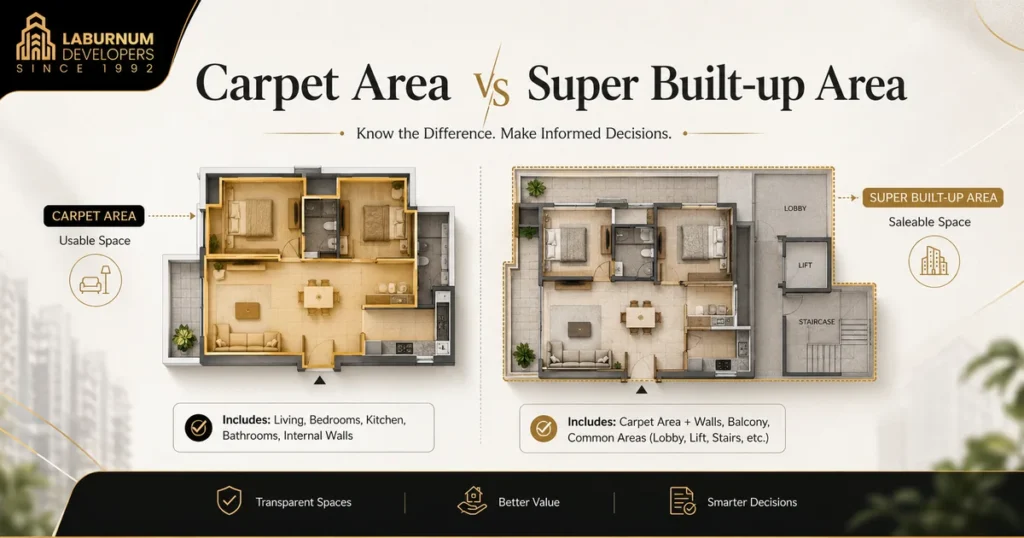
What Is Carpet Area? The Space You Actually Live In
Carpet Area is exactly what the name suggests: where on earth you lay down a carpet – your carpet – within the boundaries of your home. It’s a net usable floor space only; you have all rights and claims over that – that is your living room, kitchen, bathrooms, toilets, and bedrooms. No dividing wall, no shared lobby, no lift shafts, etc. Nothing you share with your neighbours here.
As per the Real Estate (Regulation and Development) Act, 2016 (RERA): Carpet area is the net usable floor area of an apartment excluding the area covered by external walls, area covered by services shaft, exclusive balcony or verandas and exclusive open terrace area; however, including the area covered by internal partition walls.
Did you catch that? The last sentence there is key – the RERA carpet area definition includes interior partition walls (the ones that help separate your living room and your bedrooms, or your toilet from your bedroom), but does not include any interior and exterior walls (the walls on the outside of your apartment, or those shared with a neighbour, for instance). This means RERA carpet area typically comes in 3-5% bigger compared to the carpet area calculations as traditionally known.
What Does Carpet Area Include?
- Living room/drawing room
- All bedrooms
- Kitchen and dining space
- Bathrooms and toilets
- Internal staircase (within the unit)
- Thickness of internal partition walls (as per RERA)
What Does Carpet Area Exclude?
- External walls of the apartment
- Balconies and terraces
- Verandas
- Common areas (lobbies, corridors, staircases, lifts)
- Service shafts and utility ducts
Simple Formula: Carpet Area = Bedroom Area + Living Room Area + Kitchen Area + Bathroom/Toilet Area – Thickness of Inner Walls
In contrast, if we have three rooms totalling 450 sq ft, a living area of 180 sq ft, a kitchen of 90 sq ft, and two bathrooms of 40 sq ft each for a 3 BHK, this works out to roughly 800 sq ft (net minus a small margin for the internal walls.
What is a Built-Up Area? One Step Beyond Carpet
Thickness of all the walls – inner as well as external, and exclusive to your particular apartment,t as well as your exclusive veranda, balcony or terrace. To understand it more easily, a built-up area is all of the physical matter located within the boundary lines of your apartment, encompassing its boundary structures to your habitable space. Usually, the built-up area comes out to be somewhere about 10-15% more than the carpet area. Thus, if your carpet area is 800 square feet, then the built-up area may hover somewhere around 880 square feet to 920 square feet.
Formula: Built-Up Area = Carpet Area + Thickness of External Walls + Balcony/Terrace Area
Sometimes the ‘built-up area’ can also be referred to as the ‘plinth area’. Even though the builders may not focus on disclosing this fact as much as the super built-up area, it is essential to know about it because this is what basically forms the base (and not so intended pun) of the calculation for super built-up area.
Read Also… Top 10 Richest Cities in India By GDP in 2026 – India’s Wealthiest Cities
What Is Super Built-Up Area? The Number Builders Love
SUPER BUILT-UP AREA or SALEABLE AREA (also often referred to as SUPER AREA). This is the highest of the three measurement values you will generally encounter in advertisement material. This value is inclusive of the built-up area as well as the share of common facilities in the building/complex.
These common areas are shared by everyone in the building and include:
- Entrance lobby and reception area
- Staircases and fire escape passages
- Lift shafts and machine rooms
- Corridors and passageways on each floor
- Clubhouse, gym, and swimming pool (in some projects)
- Security cabin and guard rooms
- Electrical sub-stations and generator rooms
- Parking management areas
The share allocated to you for these common areas is determined on a proportionate basis depending upon the size of your unit in relation to the total built-up area of all units in the building. Proportional load factor (also termed as load percentage or efficiency ratio) is added for this purpose to your proportionate area in common areas.
Formula: Super Built-Up Area = Built-Up Area + Proportionate Share of Common Areas
Alternatively: Super Built-Up Area = Carpet Area × (1 + Loading Factor)
Loading factor can differ drastically in different projects, ranging between 25% – 45% in general. If the project is loaded with extra facilities like plush lobbies, additional elevators and a sprawling clubhouse, the loading factor will be relatively high, which means you pay for something more than you would be living in.
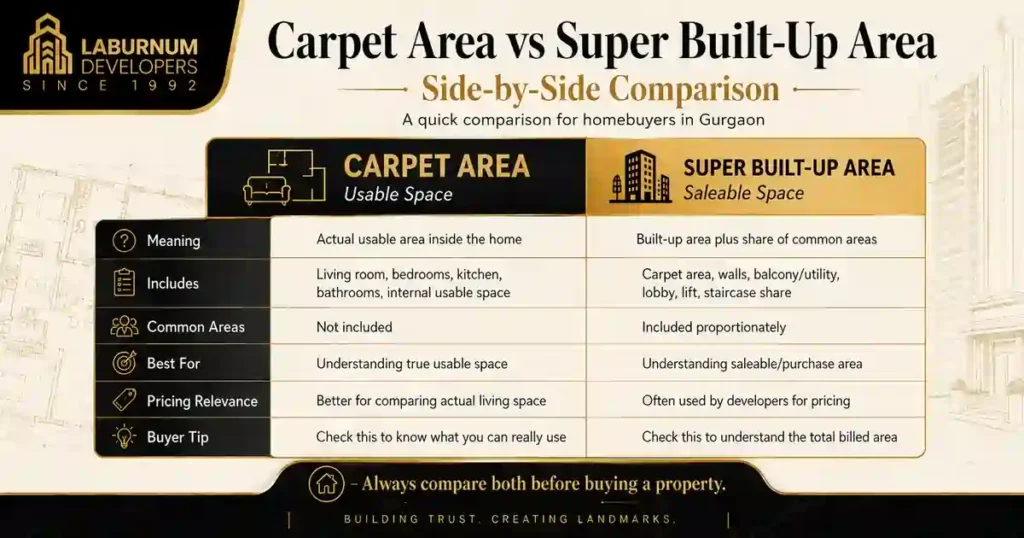
Carpet Area vs Super Built-Up Area: Side-by-Side Comparison
The Loading Factor: The Hidden Variable That Changes Everything
Of all the topics in this discussion, this may be the one key you have to grasp! The loading factor is the percentage you are adding to your carpet area to get to the super built-up area, or it is the amount that you pay, per square foot, for space you are not using yourself.
How to Calculate the Loading Factor: Loading Factor = (Super Built-Up Area ÷ Carpet Area) – 1 × 100%
So if a flat has a super built-up area of 1,200 sq ft and a carpet area of 850 sq ft, the loading factor is: (1200 ÷ 850) – 1 = 0.41, or 41%.
Put another way, 71 percent of the price you pay is attributable to the square footage of your real usable living space when you translate the expense from a cost per square foot price (such as dollars per square foot) into an actual usable living space. Therefore, when choosing between two properties that are equal in price, the loading factor of those spaces has an indirect, negative correlation with their total overall value.
Read Also… Revolutionizing Real Estate: Impact & Benefits of RERA ACT
Loading Factor Benchmarks
| Loading Factor Range | What It Means |
| Below 25% | Excellent – Very efficient use of space |
| 25%-30% | Good – Standard for well-designed projects |
| 30%-40% | Average – Check amenity value carefully |
| Above 40% | High – Ensure common areas justify the cost |
A Real-World Example: What 1,000 Sq Ft Actually Means
Let’s say you are looking at a property advertised as 1,000 sq ft. Here is how the three area types could break down:
- Super Built-Up Area: 1000 sq ft (as per advertisement)
- Common Area Share: About 82 sq ft (about 10% of the Built-Up Area)
- Carpet Area: About 650-700 sq ft (the area where you actually reside).
This means that you’ll be entering a 1000 sq ft flat, but you’ll have only 650-700 sq ft of usable living area! When the price of the property is quoted at ₹8000 per sq ft of super built-up area, it means that a person is actually paying ₹11400-₹12300 per sq ft of carpet area. The knowledge of this will allow you to compare the actual costs between projects.
However, if, in a different project, you get a flat of ₹9,000/sq ft super area, but its loading factor is a much lower 28%, then your effective carpet area cost would be ₹12,500/sq ft. The projects start to look more and more alike than their proposed headline price would indicate. Basically, without a loading factor, the per sq ft rate doesn’t make sense.
How RERA Changed the Rules: A Buyer-Friendly Shift
Before 2016, there was no standard definition for carpet area, built-up area or super built-up area in India. Builders could (and did) use these freely – some inflated them, others calculated them inconsistently. Buyers would end up receiving much less space than they anticipated.
The Real Estate (Regulation and Development) Act, 2016 (RERA) changed this significantly. Under RERA:
- All RERA-registered projects must clearly disclose the carpet area (as per the RERA definition) in all sale agreements.
- Developers cannot sell property based solely on super built-up area without specifying the carpet area.
- Any increase in carpet area after the agreement is signed must not exceed 3%.
- If the delivered carpet area is less than agreed, buyers are entitled to a proportionate refund.
- Approved floor plans and area calculations are publicly available on state RERA portals.
This is huge protection for buyers and you as well. The very next thing you must do before signing any document is to check the registered carpet area details for your respective state on its RERA website (harerait.org.in for Haryana) and ensure the same is as advertised by the developer.
Why This Matters Specifically When Buying Property in Gurgaon
Gurgaon (formerly named Gurugram) – A booming property hotspot in India. The property market of Gurgaon includes high-rise apartments, low-rise builder floors, plotted projects and villas, along with different pricing that is different for each. There are generally higher loading factors of 30% to 45% when it comes to buying a high-rise apartment, on account of a more common area that includes additional lifts, spacious lobbies, amenities and parking spaces.
Builder floors or low-rise projects, on the other hand, are generally seen to have much lower loading factors than those in high-rise apartment projects, like low-rise builder floors in the development of Laburnum Developers.
Builder floor, for example: ‘Victory Floors 88A’ by Laburnum Developers – which is a luxurious low-rise in the developing sector 88A, Gurgaon.
When it comes to a builder floor, the shared area in a typical construction project is far less than the whole construction site. This is why, when you get your carpet area definition compared to the super build-up definition, a buyer with an understanding of this factor will know that a builder floor often gives the buyer the advantage of a much greater area on a per-square-foot calculation.
This is why, when evaluating real estate in Gurgaon, you should always:
- Ask for both carpet area and super built-up area from every developer
- Calculate the loading factor and compare it across projects
- Verify the RERA-registered carpet area online
- If possible, physically measure the unit during a site visit
- Prioritize carpet area per rupee over total advertised area
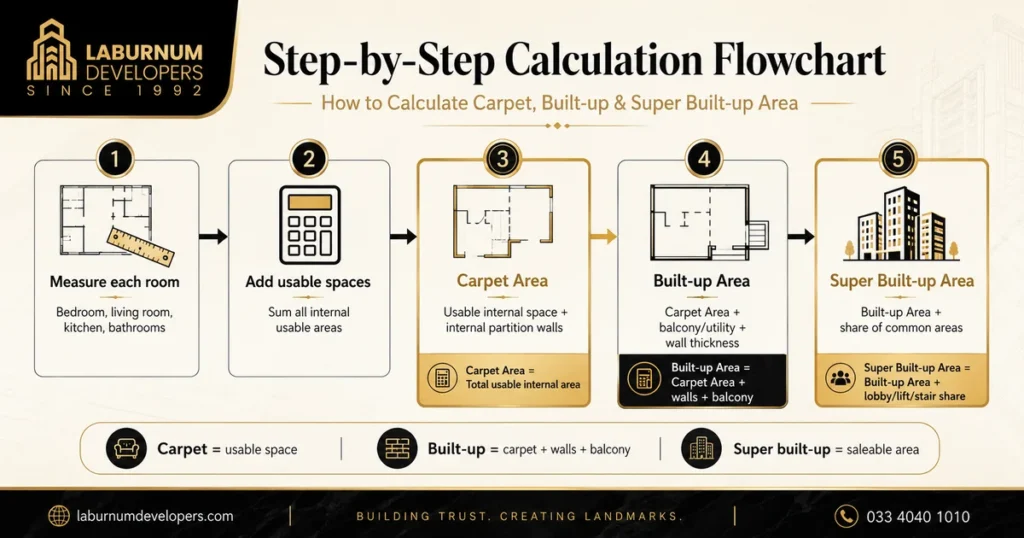
Step-by-Step: How to Calculate Carpet Area, Built-Up Area, and Super Built-Up Area
Step 1 – Measure the Carpet Area
- Measure the inside length and width of each room with a measuring tape
- Length x Width for each space, and multiply
- Total rooms: bedrooms + living room + kitchen + bathrooms
- Exclude balconies and terraces, external walls
- Note: RERA compliance requires internal partition wall thickness.
Step 2 – Calculate Built-Up Area
- Add up your carpet area
- Add all external wall thicknesses (measure inside surface to outside surface)
- Add the exclusive area of balcony/terrace/veranda
- The outcome is your built-up area
Step 3 – Locate Super Built-Up Area
- Ask the developer for the total size of the common area of the building/complex
- Ask for your share based on your unit’s built-up area against the total built-up area of the project
- Add this share proportionally to your built-up area
- Or utilise: Super Built-up Area = Carpet Area x (1 + Loading Factor / 100)
Smart Homebuyer Tips: Getting the Most Out of Your Investment
Armed with this understanding, here are the most important actions to take before finalizing any property purchase:
- Always ask the developer to share the carpet area first and then the super built-up area – not vice versa.
- Effective Price per sq ft of carpet area = Total Price/Carpet Area. Compare that number between projects.
- Check the size yourself with the RERA-approved floor plan download from the state portal.
- Beware of projects that have big clubhouses, wide corridors or multi-level lobbies – they can increase the loading factor a lot.
- For investment purposes, a lower loading factor means more rental income per rupee invested because tenants pay for usable space.
- Make it mandatory that the RERA carpet area is mentioned in the sale agreement and not only the super built-up area.
Laburnum Developers: Where Transparency Is Built In
With years of experience, Laburnum Developers has been providing premium residential properties in Gurgaon, with one constant commitment – you always know exactly what you are buying. We think confusion about area measurements is not just a nuisance – it erodes trust, which is the foundation of any long-term builder-buyer relationship.
Our portfolio of projects across Gurgaon’s most sought-after sectors reflects this philosophy:
- Victory Floors 88A (Sector 88A) – Premium low-rise floors with efficient layouts and minimal loading factors
- Victory Floors 63A (Sector 63A) – Spacious builder floors combining modern architecture with maximum usability
- Victory Floors 89 (Sector 89) – Thoughtfully designed residences with transparent area disclosures
- Laburnum Homes 82A (Sector 82A) – Affordable luxury with RERA-compliant documentation
- Victory Floors 83 (Sector 83) – Contemporary homes built for the discerning Gurgaon buyer
Every project we build is fully RERA registered with clear disclosure of carpet area in all agreements. We have an open-door policy for buyers who wish to walk through the unit and check dimensions before they commit. At Laburnum Developers, we’ll show you what 1,000 sq ft really looks like when you buy with us.
Want real transparency in real estate? See our latest projects or get in touch with our team to arrange a site visit today.
Frequently Asked Questions (FAQs)
Q1. What is the difference between carpet area and super built-up area?
Carpet area is the actual usable floor space inside your home – the space where you walk, put furniture and live. Super built-up area (also called saleable area) is your carpet area plus the wall thickness, balcony and a proportionate area of all common areas in the building like lobbies, lifts, staircases and corridors. In most projects in Gurgaon, the carpet area is 60-75 percent of the super built-up area.
Q2. Which area should I focus on – carpet area or super built-up area?
Pay close attention to the carpet area while considering livable square feet. The developer determines prices based on the super built-up area, which includes the common area with other residents. When you compare two homes, it is essential to make an Apple-to-Apple comparison by computing the effective price per square foot of the carpet area – (Total Price/ Carpet Area).
Q3. Is carpet area defined by RERA? Does the RERA carpet area include the balcony?
Yes, carpet area has a specific definition in The Real Estate (Regulation and Development) Act, 2016. RERA defines Carpet Area as – the area of a house to include the floor area of the usable internal walls only, but shall not include the area of Balconies, Varandahs, Terraces, external walls and the area of an air conditioner. So, NO RERA Carpet area includes BALCONY AREA. Developers must provide the RERA Carpet Area in the Sale Deed Agreement for Registered Projects.
Q4. What is a loading factor, and how do I calculate it?
Loading factor: This is a percentage added to the carpet area that represents the proportional value of common areas. This is used for calculating the super built-up area. The formula for the loading factor is: loading factor = [(Super Built-Up Area – Carpet Area) / Carpet Area] * 100. e.g., if your Super Built-up Area is 1200 Sq Ft & carpet area is 850 Sq Ft, your loading factor will be approx 41%.
Q5. Can the carpet area delivered by a builder differ from what was promised?
Yes, there could be some minor deviation based on the ground realities of construction. However, as per RERA, the variation in carpet area cannot exceed 3% of the mutually agreed-upon area. If the deviation is within the limits of 3%, it is possible that the buyer might have to pay or receive a refund based on proportional deviation.
And if it’s more than 3%, the buyer is free to pull out from the agreement and get the entire money refunded.
Check the carpet area received at the time of possession against the RERA specification.
Q6. Why do builders advertise super built-up area instead of carpet area?
Builders usually sell ‘super built-up area’ because it works out at a lower price per sq ft, and the unit costs make the property look cheaper for marketing purposes. For example, a flat at R8,000 per sq ft of super built-up area might cost you 11,000-12,000 per sq ft on carpet area. Though RERA mandates that carpet area be mentioned in all agreements from 2016 onwards, builders tend to lead marketing materials with the super built-up area.
Q7. Is carpet area the same as floor area or covered area?
No. Although the terms are related, they are not the same. Floor area implies the total surface area of the flooring slab of the building & encompassing all its portions.
Covered Area is the space under any cover that contains walls.
However, RERA does not cover the total common area. Carpet area means floor space confined within the inner walls of the apartment. The carpet area by RERA will give you a precise definition of carpet area.
Q8. In builder floor apartments like those in Gurgaon, is the loading factor lower?
Yes, as a thumb rule. But in the case of Builder Floors in Gurgaon, which have three to four storeys in each structure, not usually more than four floors high, and are semi detached structure, the ratio between the shared space and the occupied space in the unit is significantly less because a Builder floor does not have multi-storey lobbies with multiple lifts or a multi- storey clubhouse. Accordingly, the loading factor for a builder floor in Gurgaon is usually around 15 to 25 percent, whereas it may be anything from 30 to 45 percent for a high-rise apartment. Hence, a builder floor is preferred by the purchasers for the want of optimum useful space for the price paid by them.
Conclusion: Knowledge Is Your Best Real Estate Tool
The gap between a carpet area and the super built-up area is not merely semantics. In fact, that’s the gap between buying the smart home versus buying blind! In an expensive real estate hub like Gurgaon, where the property we decide on today could change our financial futures for years, the distinction is worth every penny.
To summarise the key points:
- Carpet area = actual usable living space (governed by RERA, most important for buyers)
- Built-up area = carpet area + walls + exclusive balcony
- Super built-up area = built-up area + proportionate share of common areas (what developers use for pricing)
- Loading factor = the percentage gap between super built-up and carpet area (lower is better)
- Always insist on RERA-compliant carpet area disclosure before signing any agreement
With our ventures in Gurgaon, we focus on making every square inch of the carpet area work in your favour. We’re committed to complete transparency, ensuring you’re fully aware of what home you’re heading back to – from the minute you make a choice and long thereafter. Whether you’re an all-new home-seeker or a savvy investor, we’ve got you all the way.
Read Also… Luxury Floors in Gurgaon: Why 3 BHK + Study at Anant Raj Estate Is Gurgaon’s Best Investment in 2026



Comments are closed