




Table of Contents
Learning how to register property online in India can save you days of running between government offices. While the process has become significantly more digital – with document uploads, stamp duty payment, and appointment booking all available online – the final registration step still requires a physical visit to the Sub-Registrar’s office. This guide walks you through every stage, from gathering documents to collecting your registered sale deed.
What is Online Registration of Property in India?
A home is among the greatest economic choices in the lives of many, and registering the home is the move that will make the home yours legally. Today, it is no longer just lawyers and brokers who need to know how to register property online in India, but all buyers will require this knowledge prior to signing any documents.
The registration of a property is the process of having the transfer of ownership of a property (flat, independent house, builder floor, or plot of land) confirmed by the state government in the land register and acknowledging you as the legal owner according to the law. Moreover, if you register your transaction on the land register, it will be permanently recorded on the Land Register.
Fortunately, nearly all the states in India have developed an electronic version of many parts of this process. Access to property records online is now available, as well as an online stamp duty calculator, online registration fee, and online appointment booking with the Sub-Registrar. But by this time in 2026, you can’t register without appearing at a government office. All attendance is required.
Why Property Registration Is Legally Important
The Registration Act, 1908 provides that all transactions relating to immovable property of value exceeding ₹100 are to be registered; in the current context, it is seen that nearly all transactions relating to immovable property in India exceed this value; it is therefore more like a requirement to register all immovable property transactions. A sale deed is not a document of title in court if it is not registered.
It is important to emphasise what registration does and what it doesn’t do. The fact that the transaction is registered creates a public record of the transaction, a nd that, in the event that there is a competing claim, the registered transaction takes priority. The registrar’s role is primarily a procedural one, for he’s merely ensuring that a transaction occurred, not that the seller had good title to sell. This is why the verification of titles, searches, and adequate legal due diligence is still as essential as the registration process.
In addition to a legal guarantee, there are also financial advantages of a registered property. The advantage of a registered deed is that it allows you to take out a mortgage on the property, allows the property to pass through the estate ( Inheritance) without hassles, and it safeguards you against any future claims by the previous owner or anyone else with a right to the land.
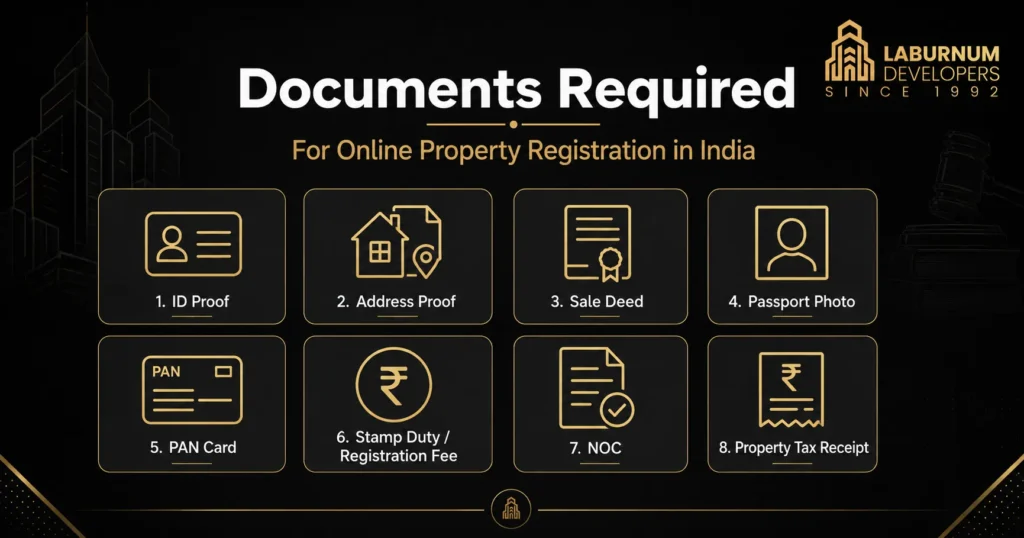
Documents Required to Register Property Online in India
Collect these necessary documents before you ever access a government portal. The main reason for registration delays is missing paperwork.
| Document | Purpose |
| Sale Deed (Draft) | A legal document that describes the property, the individuals involved, and the transaction |
| Identity Proof | Confirms the buyer, seller, and witnesses’ identities |
| Address Proof | Confirms the current residential address of both parties |
| Passport-Size Photographs | Required for biometric verification at the Sub-Registrar’s office |
| Property Title Deed / Previous Sale Deed | Establishes the seller’s legal ownership chain |
| Encumbrance Certificate | Verifies that there are no outstanding legal or financial obligations on the property. |
| No Objection Certificate (NOC) | Required for properties in housing societies or under loan |
| PAN Card of Buyer & Seller | Mandatory for transactions above a specified value |
| Stamp Duty & Registration Fee Receipt | Proof of payment, generated after online payment |
Verify again that the survey or plot number, the property address, and the names are spelled precisely the same in every document. Even a little error can cause registration to be delayed or necessitate a subsequent correction deed, which can be expensive and time-consuming.
Read Also.. What are Stamp Duty & Registration Charges in Gurgaon? A Complete Guide to Property Registration
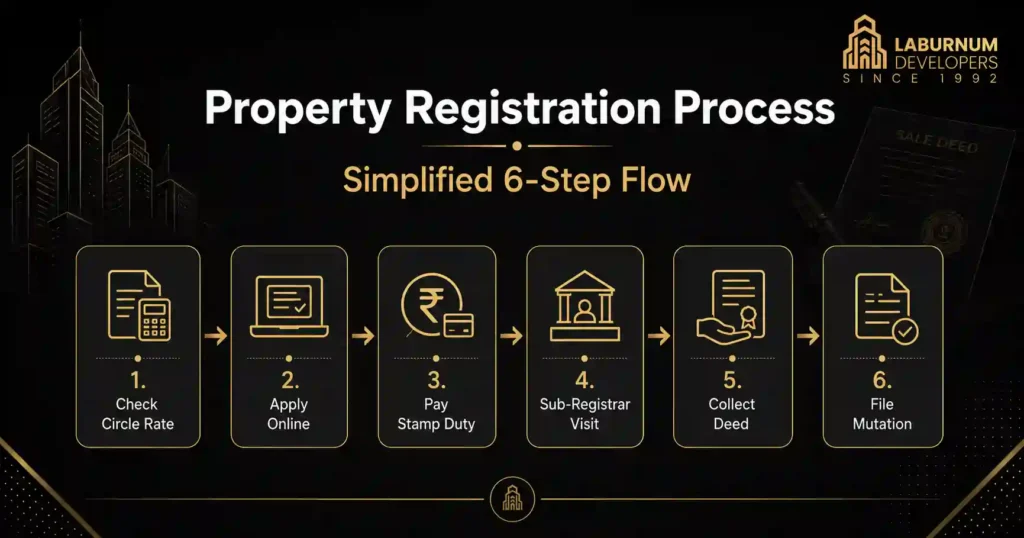
How to Register a Property Online in India: A Comprehensive Guide
The steps to complete your property registration using your state’s online portal are as follows:
Step 1
Review the Circle Rate. Each state has a minimum price per square foot or per square yard for each locality, which it calls the circle rate, ready reckoner rate in Maharashtra, or guidance value in Karnataka. The higher of the circle rate or the value of the transaction will be the amount of stamp duty paid.
Step 2
Go to Your State’s Official Registration Portal. Every state has its own portal, like IGR Maharashtra, Kaveri online services in Karnataka, Banglarbhumi in West Bengal, and Jamabandi in Haryana. To avoid the intermediaries that can scam you, use the official government site for all such purposes.
Step 3
Sign up or sign in on the Portal. New users register on the basis of their name, mobile phone number, and email address. Existing users log in as usual.
Step 4
Fill the Application Form. Insert property location (state, district, village/town), property type, buyer details, seller details, and market value of the property. Make sure of all entries, as it may take longer if they are wrong.
Step 5
Work out and pay Stamp Duty & Registration Fees. Most portals have an inbuilt calculator that calculates the stamp duty (usually 4-10% of the property value, depending on the state) and registration fee (usually 1%). Normally, payment is made directly via the portal.
Step 6
Prepare Sale Deed. The sale deed should clearly identify the property (survey number, extent, boundaries), the names of the grantor and grantees, the amount of consideration, and conform with the formatting standards set forth in your state. This document should be prepared and/or checked by a property lawyer, and it is advisable to get this document prepared — if it is not drafted correctly, it is difficult to correct it after registration.
Step 7
Schedule a meeting with your Sub-Registrar. With the usage of an Aadhaar number, most states now allow online appointment scheduling through their IGRS (Information Governance and Regulation) portals. Make an appointment at least one week in advance because walk-in appointments are not often accepted in urban offices.
Step 8
Visit the office of the Sub-Registrar. In addition to the buyer and seller (or their designated Power of Attorney holders), two witnesses with legitimate identification documentation must be present in person. Biometric verification, document verification, and formal execution of the deed by all parties are necessary.
Step 9
Obtain the Registered Sale Deed. The registered document will arrive with an official seal and number and is typically returned the same day or within two working days. Usually, you can obtain a digital copy from the portal.
Step 10
Submit a Mutation Request. Mutation and registration are unrelated to one another. To make sure that the land records for the property are updated for taxes, you should change the property records as soon as you become the new owner.
Recap of Online vs Offline Steps
Complete Online Steps: Opening Account, Application Form, Stamp Duty Calculation, Payment of Fees, Booking Appointment, and Download of Deed.
Mandatory In-Person Steps: Completing the Biometric Verification, Signing the Deed in the Presence of Witnesses, Executing the Deed at the Office of the Sub-Registrar.
Total Time: — 7 working days once Documentation is Ready for the Full Registration Process.
Stamp Duty and Registration Charges Explained
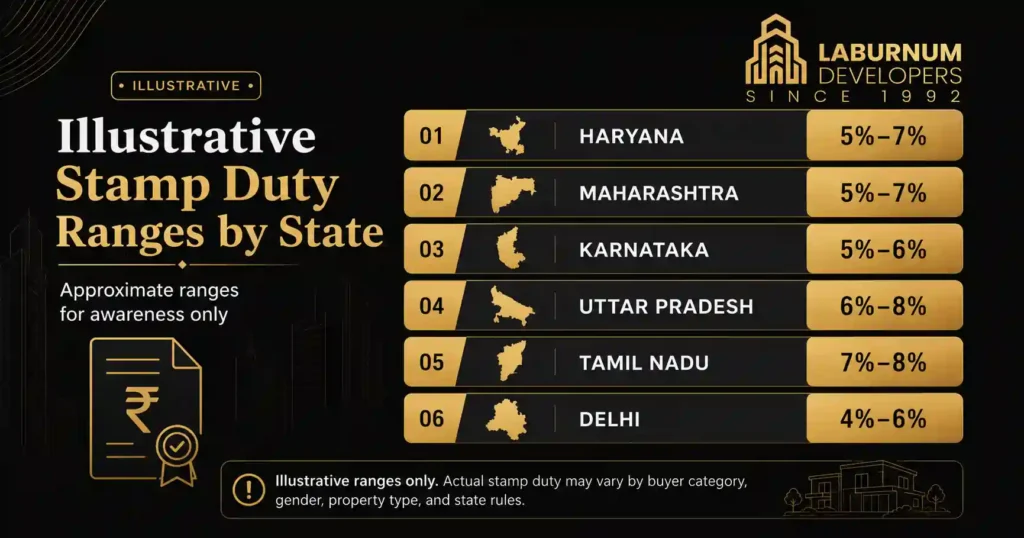
Stamp duty is typically the highest single cost in any property registration, and it varies significantly by state — and in several states, by buyer gender, with women often receiving a 1–2% concession to encourage property ownership.
| Charge Type | Typical Range | Notes |
| Stamp Duty | 4% – 10% of property value | Varies by state; women often get discounts |
| Registration Fee | ~1% of property value | Mandatory across all states |
| Sale Deed Drafting | ₹3,000 – ₹10,000 | Depends on property complexity |
| Lawyer’s Fees | Variable | Optional but strongly recommended |
| NOC / Miscellaneous Charges | Variable | For society or loan-linked properties |
It’s important to double-check the current stamp duty and registration fees available to you before executing a real estate transaction, as they can change frequently, often at the beginning of a new fiscal year. Additionally, if you register before March 31, you may be eligible for some tax deductions under the Income Tax Act for the current fiscal year.
State-Wise Online Property Registration Portals
Each Indian state operates its own dedicated online registration system. Below are some of the most commonly used portals as of 2026.
| State | Portal Name |
| Haryana | jamabandi.nic.in / edisha.gov.in |
| Maharashtra | igreval.maharashtra.gov.in |
| Karnataka | kaveri.karnataka.gov.in |
| West Bengal | Banglarbhumi |
| Delhi | shcilestamp.com / Delhi Online Registration |
| Telangana | bhubharati.telangana.gov.in |
| Uttar Pradesh | IGRSUP |
The buyer will use the Haryana government’s Jamabandi portal to verify documents when buying either a builder floor or an apartment in Gurgaon, and then will use the appropriate Sub-Registrar office to execute the documents. Since Gurgaon is part of Haryana, the buyer should confirm which Sub-Registrar office serves their sector before making an appointment.
Common Mistakes to Avoid During Online Property Registration
Skipping the Encumbrance Check
One of the most common and costly mistakes for buyers is failing to check the property encumbrance certificate. When you don’t do this, you’re leaving yourself exposed to any previous transactions/disputes that may be pending and/or encumbrances related to that property; you may also have to pay off a loan that was taken out by someone else against the property you’ve bought.
Errors in Names or Property Description
All Errors in registered deeds—misspelled names, Incorrect Survey Numbers, and mismatched addresses—will cause the Need for Additional Time And Money for An Additional Correction Deed. It Is Extremely Important to Proofread All Documents Multiple Times Before Attending the Registration Appointment.
Delaying Mutation After Registration
A lot of people think that just registering their property completes the transfer of ownership, but they also need to perform an additional step called mutation, which consists of changing the municipal and revenue records to reflect the name of the new owner, as soon after the date of registration as possible, to avoid potential issues with their property tax records in the future.
Not Verifying the Seller’s Title Independently
Don’t forget that as an officer of a Sub-Registrar, you are primarily involved in the process of registering property, so you do not confirm that the seller’s title of the seller is clear. You need to check the title of the property through independent legal due diligence (ideally with a Property Law expert) prior to signing any contracts.
Can NRIs Register Property Online in India?
These are a few ways in which NRIs can purchase property in India, provided that they have met some additional criteria. In case you are unable to come back to India to complete the transaction yourself, you will need to obtain a power of attorney (PoA). This PoA will need to be notarised by a local notary public in your country. After notarising the PoA, it must be either apostilled (Hague Convention) or attested by the nearest Indian consulate before you can use this document to sign a property transaction in India.
Typical documents required for an NRI buyer are as follows: An NRI buyer will also need to provide a valid Indian passport, PAN Card; proof of foreign residency address in addition to the normal documentation required for a resident buyer.
If you are an NRI looking for luxury apartments in Gurugram, then use our 3 BHK to browse RERA-compliant builder floors that are fully documented.
FAQs: How to Register Property Online in India
Q. Can I register property online without visiting the Sub-Registrar’s office?
No, even if most steps in the process can be done on the internet (document upload, stamp duty calculation, fee payment, and appointment making), the last step involves you going to the Sub-Registrar’s office in person to take a fingerprint/biometric verification and sign the deed in front of two witnesses. India uses a hybrid system and is part physical and part (hybrid) online.
Q. How long does online property registration take in India?
The online segment of the registration procedure is fast; however, completing the whole registration — preparation of a document, visiting your Sub-Registrar site, verification, etc. — usually takes anywhere from 2-7 working days, depending on your state and the completeness of your preparation documentation. Some states that have detailed physicals may take longer.
Q. Is property registration mandatory in India?
According to the Registration Act 1908, section 17, any transfer (sale) of immovable property that is valued above Rs. 100 is mandatorily required to be registered; this means practically every property transaction today is over Rs. 100 and therefore requires to be registered. Failure to register your sale deed means that you cannot use it to prove your ownership in court; thus, you must register your land or real estate property before making any other transactions with it to protect your legal rights.
Q. Can NRI buyers register property online in India?
To answer this question; NRIs are permitted to register properties within India; however, if they do not have a physical presence at the time of signing, they can execute a Power of Attorney document in their country of residence, which has to be notarized and will need to either be apostilled or attested at the Indian consulate before being registered in India before it can be executed on behalf of the NRI. In addition, an NRI will typically need a valid Indian passport, PAN card (for tax purposes), proof of a current local address overseas, along with all other normal documents necessary for executing real estate transactions.
Q. What is the difference between stamp duty and registration charges?
When purchasing property, stamp duty is a tax that the state government requires to be paid to enforce a legal property transaction. Each state uses its own stamp duty rates based upon the approximate market value of the property. In most cases, stamp duty rates range between4% and 10%% based on where the property is located.
Registration fees are a separate charge and are applied to the recording of a property in the government’s records. Registration fees are usually about 1% of the property’s value.
Q. What documents are required for property registration in India?
To complete your property transactions, you need a few key documents:
1. The Draft Sale Deed
2. Identification Proof (Aadhaar & PAN) for the Buyer & Seller
3. Address Proof
4. Passport-size Photographs of Both Parties
5. Old Title Deed of the Property
6. Encumbrance Certificate
7. NOCs, if required (especially for Society or Mortgage/end-buyer loan-linked transactions)
8. Proof of payment of Stamp Duty & Registration Fees
When registering your property, you will also need two witnesses with valid ID proof to sign as witnesses to the transaction.
Q. What happens if a property is not registered in India?
You cannot view an unrecorded real estate transfer as giving you an official record of owning that property. An unrecorded deed will not be enforceable in court; you will have a challenging time using the property to obtain a mortgage with some lenders, and you will have difficulties transferring title to your heirs or selling it in the future. The act of registering real property is the way that an informal agreement becomes a legally enforceable record of ownership.
Q. How do I check the circle rate before registering my property?
Go to your state’s official land record/registration website, then type in your property’s location, such as district/locality, and you will see the circle rate (often called the ready reckoner rate in Maharashtra, guidance value in Karnataka). The circle rate is normally used as the basis to calculate stamp duty for both nominal transactions and non-cash transactions made for the same property. Therefore, check the Circle Rate prior to making any actual commercial transaction in order to give you a more accurate estimate of your total business registration costs.
Conclusion: Making Property Registration Stress-Free
When you’re fully informed about registering property online in India, it gives you confidence while creating one of the largest investments of your life, instead of creating confusion. The registration process has significantly increased in transparency and become more convenient since all documentation can be uploaded to the state’s website, and bills and support are available. However, once all of your documentation has been submitted and recent bills are available, ultimately you must return to the Sub-Registrar’s Office for the last legal step of signing your documents in person.
This last point emphasises that preparing for an easy registration is the most critical. Prior to returning to the Sub-Registrar’s Office for the last step in your registration process, make sure that you gather your entire documentation, verify the seller’s title through an independent source, calculate your stamp duty and registration cost correctly, and check the accuracy of all details within your Sale Deed prior to signing. Being diligent now will allow you to avoid headaches and challenges related to your registration.
At Laburnum Developers, we want to make purchasing your home an exciting journey and not an overwhelming one. Therefore, our team will assist you through the entire process of purchasing a property by completing all documentation and registration while ensuring the most legal processes are completed properly and transparently.
Explore the premium builder floor projects that we have available in Gurugram, where our team will help you with every aspect of purchasing and registering your new home.
For official, state-specific stamp duty and registration rates, you can always verify current figures directly on your state’s official IGRS government portal before proceeding with your transaction.
Read Also… Stilt+4 Floor Rule in Gurgaon: What Buyers Must Know in 2026



Comments are closed