



Table of Contents
Everybody has experienced that initial walk-through feeling when entering a house for the first time. It either fits or doesn’t fit. It’s warm, it’s quiet, it’s something other than calm, but it’s not quite uncomfortable. This phenomenon has been followed for more than 5,000 years by the ancient Indian science of architecture and spatial arrangement known as Vastu Shastra. Today, many homeowners and buyers rely on Vastu Tips for Home to create harmonious living spaces that promote positivity, well-being, and prosperity.
What Is Vastu Shastra and Why Does Home Flooring Matter?
Vastu (from the Sanskrit word Vaas, which means dwelling) is a system of principles that were codified with the purpose of influencing the design, orientation, and finishing of a dwelling in harmony with the five elements (earth, water, fire, air and space) and to direct the flow of natural energy in a way that creates health, wealth and happiness for those that inhabit it. Vastu is not superstition, but some of its tenets closely correspond to the findings of contemporary environmental psychology: natural light orientation, airflow, spatial symmetry and materials all have measurable effects on human wellbeing.
Flooring is one of the most overlooked aspects of a home in terms of Vastu. It extends across the entire area of your home. It’s the ground you walk on, kids play on, old parents sleep on. The floors in your house link together all rooms, add a sense of weight to each space, and, according to Vastu, either facilitate or obstruct the flow of energy in your home.
Whether you are new to the home, are undergoing renovations, or just thinking of redecoration, it is true to say that the application of the Vastu tips for correct home flooring can make a difference — not merely in the spiritual aspect, but ultimately in the way your home feels to live in every day.
Vastu Tips for Home Flooring — The Complete Checklist
Before we get into the room-by-room details, here is the foundational checklist that governs Vastu-compliant flooring across the entire home. Think of this as your master reference before you pick a single tile or slab.
1. Choose Light Colours Over Dark.
In Vastu Shastra, wherever flooring is required for construction, light colours (hypothetically, warm and neutral) should be used. For example, dark-coloured (e.g., grey or dark brown or black) floors may absorb negative energy instead of letting negative energy travel freely through a home. Alternatively, lighter colour floors can create a more positive, lightened feeling in the space as they allow natural sunlight & positive energy to be reflected to the area where the floor is located, thus creating a more inviting and airy environment.
2. Maintain Uniformity in Floor Level.
All floors in the entire house should be level and flat. If your home has sunken areas in the living room, a raised platform area in the bedroom, or uneven flooring connecting the different rooms of your house, then these things create Vastu defects. They upset the energy flow and will cause the people living in or using these parts of the house to feel unbalanced subconsciously.
3. Use Evenly Cut, Regular-Shaped Slabs:
Vastu stresses the use of tiles and slabs that have a consistent shape — square or rectangular (like most floor tiles). Tiles with irregular shapes, broken cuts, and/or random designs are said to produce imbalance in the energy of the space.
4. Fix Cracks Immediately:
Cracked or broken flooring is one of the most significant Vastu defects a home can have. Structurally, cracks indicate foundation stress. From a Vastu perspective, they represent breaks in the energy grid of the home — gaps through which positive energy escapes and negative energy can enter. If a crack cannot be repaired immediately, covering it with a rug or carpet is an acceptable interim measure.
Read Also.. Laburnum Developers’ Vision for Premium Living in Gurgaon
5. Avoid Gaps Between Tiles:
Wide or uneven grout lines, lifting tiles, and gaps in the flooring are Vastu defects associated with health concerns for the occupants. Ensure professional installation with tight, even grout lines throughout.
6. Keep the Same Material and Size Throughout:
Where possible, Vastu recommends using the same type and size of flooring material throughout the house and between rooms. A consistent flooring language creates visual and energetic continuity, which is associated with harmony in family relationships.
7. Be Careful with Inlay Work:
Decorative inlay work on flooring — patterns, borders, motifs — is a beautiful traditional Indian design choice. Vastu guidance here is specific: ensure that any inlay or border pattern is cut evenly at the edges and completes cleanly. An unfinished or unevenly cut inlay at the edge of a room is considered a Vastu defect that can negatively affect financial prosperity.
8. Slope Direction Matters:
If the floor has any natural slope (for drainage purposes in bathrooms and kitchens), Vastu specifies this should slope toward the north or east — never toward the south or west. The northeast corner of any room is considered the most sacred and energetically powerful, so it should always be at a slightly lower or equal level compared to the southwest.
Best Flooring Colours According to Vastu for Each Room
In Vastu Shastra, colors are useful tools. Each direction in your house relates to one of the four elements; therefore, there is a color scheme for each direction’s corresponding element. Here is a color schedule to use when selecting flooring for each room of the house.
Living Room (North or Northeast Facing)
The living room is where social interaction occurs, and so it is one of the most important areas in a home. The living room should have a welcoming, airy, and cheerful energy. For your living room flooring use cream, off white, yellow/cream colored, or pale green for your living room flooring. These colors are related to the earth and wood elements of Vastu that represent the North and Northeast directions, respectively; additionally, they encourage friendly conversations, interaction, and concentration.
Master Bedroom (Southwest Zone):
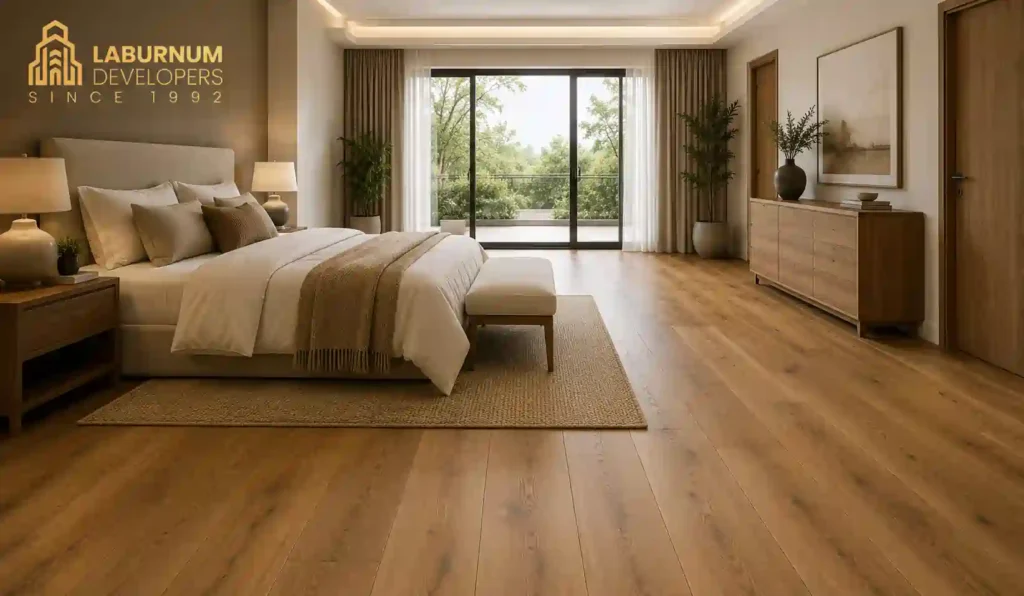
The southwest is ruled by the earth element and symbolizes security, renewal, and stability. Therefore, the flooring should be finished in either beige, tan, light brown, or muted stone colours (eg: tan, beige) rather than cool blue or green colours. All of these colours will provide the peace of mind needed for falling asleep or during rest.
Read Also.. Ambience Mall Gurgaon: Location, Shopping & Dining Guide 2026
Children’s Bedroom – West Zone
The west is ruled by the metal element and represents creativity and learning, so it is generally preferred that the bedroom flooring is finished in light grey/white/soft blue colours. The calmness provided by these colours will assist children in maintaining mental engagement and focus when studying or sleeping.
Kitchen (Southeast Zone):
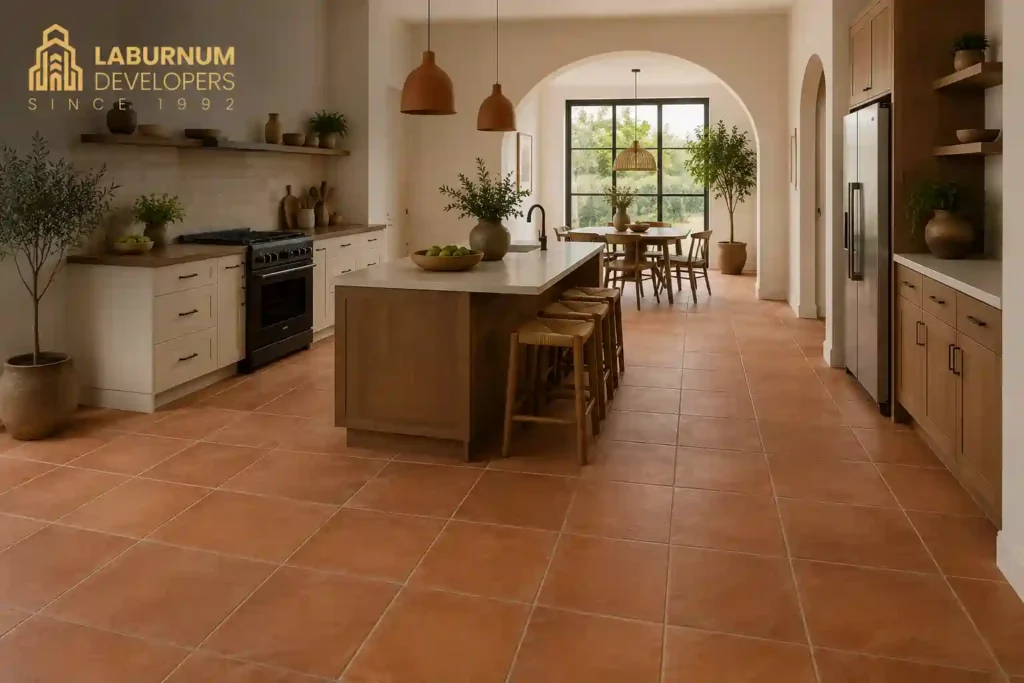
The southeast is the zone of fire — governed by the fire element. Vastu recommends flooring in shades of red, pink, orange, or warm terracotta for the kitchen. These warm tones align with the fire element and are believed to enhance the nourishing, energetic quality of the kitchen space.
Prayer or Meditation Room (Northeast Zone):
The northeast is the most spiritually charged corner of any home in Vastu. Flooring here should be white, pale yellow, or light cream — pure, clean, and reflective of light. Avoid dark or heavily patterned flooring in this zone entirely.
Bathroom (West or Northwest Zone):
In Vastu, bathrooms are best located in the west or northwest. For flooring, light blue, white, or pale grey shades are ideal — they connect with the water element and maintain the cleansing, releasing energy appropriate for this space.
Vastu-Recommended Flooring Materials: What to Use and Where
The material of your flooring carries its own energetic signature in Vastu. Here is a breakdown of the most common flooring materials and their Vastu properties.
Marble Flooring
Marble is generally considered one of the most auspicious flooring materials in Vastu Shastra. It is naturally cool, smooth, reflective of light, and has been used in sacred Indian architecture for centuries. White or cream marble is particularly recommended for living rooms, pooja rooms, and entrance foyers.
Important caveat: Vastu specifically advises against using marble in the Ishanya corner — the northeast corner of the home or room. The northeast is associated with water energy, and marble in this zone is believed to create an imbalance. Light natural stone or wooden flooring is preferred in the northeast instead.
Black marble and very dark marble are generally discouraged in Vastu for the same reasons that dark colors are discouraged — their tendency to absorb rather than reflect energy.
Wooden Flooring
If you want to make your home as pleasant and harmonious as possible, here are some things to keep in mind when choosing floors.
The wood elements of the east, north, and northeast zones are considered the “natural” zone in Vastu. The wood and water elements govern these zones and create a strong connection between the two. Therefore, if your living room has a north- or east-facing window, the bedroom is in the east section of your home, or the study is in the northeast corner, you should definitely use wooden flooring. In these areas, using wooden floors creates an uplifting, encouraging vibration that resonates well with Vastu principles.
The best natural colours of wood that will work well with both the wood and water elements are the “neutral” colours of honey oak, warm walnut and pale teak. If you prefer dark finishes on wood, be aware that they can produce the same type of negative energy associated with very dark marble. Darker woods should only be used selectively (e.g., as a feature on a wall or piece of furniture) rather than take over the entire surface area of the room with flat floorboards.
Read Also.. Top 10 Cleanest Cities in India 2026: Latest Swachh Survey Rankings
Ceramic and Vitrified Tiles
Ceramic and Vitrified tiles are by far the most commonly used modern flooring materials, and offer enormous possibilities for using these materials in compliance with Vastu. In addition to using the proper colours for floors, use ceramic or tiled floors of varying shapes and colours (rectangular, hexagonal, etc.) for greater movement and balance within the home. For example, in living rooms, use gloss tiles for flooring and create more light, reflection, and energy throughout the room.
Granite Flooring
Granite shares many of marble’s Vastu properties — it is durable, natural, and energetically stable. Light-colored granite (grey, beige, white with subtle patterns) is suitable for most areas of the home. Like marble, very dark granite — black granite in particular — should be used with caution and is best avoided as a primary flooring material.
Sandstone and Natural Stone
Natural sandstone flooring is excellent for outdoor areas, courtyards, and garden paths in Vastu. Its earthy, warm tones align well with the southwest zone of the home and exterior spaces. It is less suitable for interiors due to its porous nature and maintenance requirements.
Don’t Use These Types of Flooring
- Synthetic and vinyl (PVC) type floors: Although vinyl and other synthetic floors can be practical, they carry no natural “energetic” or vibrational association with Vastu and are best avoided if there are reasonable, budget-friendly options for partially using natural finishing materials.
- Using too many different materials: Each material and/or skill have their own unique “energies” associated with it. If you use/implement too many different types of materials and/or skills within your entire home, there will be inconsistencies created by the energy of each type combined with each other. Keep changes in the material type of flooring to reasonable transitions of logic – i.e., between indoor/outdoor spaces; wet/dry related areas.
Read Also…. What are Stamp Duty & Registration Charges in Gurgaon? A Complete Guide Property Registration
Room-by-Room Vastu Flooring Guide
Entrance and Foyer
In Vastu, the entrance is considered the mouth of the home — the primary point through which energy enters. The flooring here sets the energetic tone for everything that follows.
Use light-colored, high-quality stone or marble in the entrance. The floor should slope very gently inward (toward the north or east) rather than outward. Avoid dark, cluttered, or patterned flooring at the entrance. Keep it clean, bright, and welcoming.
If you use a doormat, ensure it is clean, firm, and placed outside the threshold — never inside.
Living Room
Vastu-improved flooring is optimal for the living area due to it being the shared family space where families spend the majority of their time together and where visitors are welcomed; therefore, the energy here will have a direct effect on the relationships of the family members and their social well-being.
The best colour choices for marble or high-gloss vitrified tiles in this area are cream, beige or light yellow. Tile should be a consistent, evenly sized pattern. As a general recommendation, tiles sized 2’x2′ are considered a very common size for a modern living room and are therefore Vastu-friendly, as well. Avoid tiles with intricate or busy designs as they will create unnecessary distractions in the living room. Instead, consider using lighter coloured marble tiles with subtle or soft veining/patterns.
Kitchen
Use warm-toned tiles in the southeast kitchen zone — pink, red, or terracotta shades connect with the fire element that governs this space. The floor must be easy to clean and maintain, as hygiene in the kitchen is a Vastu principle in itself. Avoid dark colors that make the kitchen feel heavy and suppressed.
Bedrooms
In Vastu, bedrooms are zones of rest, restoration, and intimacy. Flooring should be soft underfoot and warm in color. Wooden flooring is excellent for bedrooms in the east or north zones. In the southwest master bedroom, warm stone or beige tiles work well. Avoid cold white marble in bedrooms — it creates an energy that is too alert and bright for rest.
Bathroom and Toilets
Light blue, white, or pale grey tiles for bathroom flooring — these connect with the water element and the cleansing function of this space. The floor must slope toward a drain in the north, east, or northeast direction ideally. Avoid placing bathroom floors in pure white marble, as this creates a mismatch between the sacred association of white in Vastu and the releasing energy of the bathroom.
Basement or Lower Ground Level
If your home has a basement or lower-ground floor, Vastu recommends keeping this area well-lit and ventilated, with light-colored flooring to counteract the naturally heavier, darker energy of below-ground spaces. Light grey or cream tiles are suitable. Avoid completely dark flooring in basements.
Read Also… Stilt+4 Floor Rule in Gurgaon: What Buyers Must Know in 2026
Common Vastu Defects in Flooring and How to Fix Them
There are some easy ways to remedy existing Vastu problems in both new homes and old ones without having to do too much work at once.
Problems With Floor Tile:
– When there are cracks or broken tiles, they should be replaced as soon and as often as possible. In the meantime, cover up the crack until it is repaired by putting down a thick rug or carpet. The sooner you get rid of a cracked tile, the better.
– If you can’t get rid of dark floors quickly, try using light-coloured rugs in the main living area, entranceway and main bedroom. This will help create a more open and bright feeling.
– In situations where you have rooms with different floor heights, remodels will usually be done to raise or lower the floor levels; however, if no remodel is planned, you can minimize the energy disruption by using furniture/decor that doesn’t call attention to the difference in floor levels. Also, keep the area well lit so that they do not feel separated from each other as much.
– When two rooms have different-sized tiles or types of tile, ideally, during construction/renovation, you will use the same material/type of tile for both areas. If you cannot do this, you can strategically use area rugs to connect visually between these two floors and give the illusion of a unified area across both floors.
– Sloped floors can create a problem in your house. The best way to fix this is to have a professional come out and help you with the structural issues. Until then, you can place heavy furniture in the southwestern corner of each room to help balance the energy of the southwestern direction. In Vastu, the energy of the southwestern direction governs stability and who runs the household (the head of the household).
Vastu Flooring Tips for Your Entrance and Living Room
The entrance and living room deserve special attention because they are the two areas where Vastu’s flooring guidelines have the most immediate and noticeable impact on day-to-day experience.
For the entrance, think of the flooring as a welcome mat on an energetic level. It should be clean, uncluttered, smooth, and light. A beautiful threshold in white or cream marble — even just a 3–4 foot strip at the entry — creates a powerful first impression that is both aesthetically pleasing and Vastu-aligned.
For the living room, the floor is the canvas on which the entire room is set. Large-format light tiles (2×2 or 2×4 feet) in cream, beige, or pale gold create an expansive, welcoming energy. If you wish to add warmth, layer a natural-fiber rug — jute, cotton, or wool — in complementary shades. Avoid synthetic fur or rubber-backed rugs, as these disrupt the Vastu connection to natural elements.
One often-overlooked living room tip: ensure that the center of your living room floor — the Brahmasthan, or energy center of the space — is open and unobstructed. Do not place heavy furniture, large potted plants, or decorative objects directly in the center of the room. Allow this central zone to breathe.
How Laburnum Developers Builds Vastu-Compliant Homes in Gurgaon
Choosing the right developer can make a world of difference for homebuyers craving the peace of mind a Vastu-oriented home provides, but who may not want to be responsible for coordinating the details of their construction
Laburnum Developers, which has been in the luxury real estate business in Gurgaon since 2014, has made a name for itself as one of the fastest-growing developers of both high-quality construction as well as thoughtful implementation of Vastu principles in its residential developments. They have housed more than 500 families and delivered over 14 lakh square feet of residential projects that showcase a sophisticated understanding of the needs of Indian homebuyers (both with respect to the amenities offered, the aesthetic appeal, and the overall sense of “home”).
Their flagship projects — including Victory Floors Sector 88A, Victory Floors Sector 63A, Victory Floors Sector 89, and Laburnum Homes Sector 82A — incorporate Vastu principles at the planning stage, from directional orientation of the plot to room placement, entry points, and interior specifications. When flooring material and color specifications are finalized in these projects, they are chosen not only for their visual appeal and durability, but with an awareness of how each choice interacts with the directional energy of the home.
This integrated approach means that when you walk into a Laburnum home, that feeling of it being right — that indefinable sense of ease — is not accidental.
Victory Floors 88A (Dwarka Expressway, Sector 88A): is a collection of upscale floor plans for 4 BHK homes. Floor plans start at 2,043 square feet and feature stylish modern interiors and Vastu-compliant design. The price for each 4 BHK floor plan begins at ₹3 crore.
Victory Floor 63A (Golf Course Extension Road): is comprised of ready-to-move-in, 3 BHK + Study apartments in one of Gabriouz’s premier neighborhoods. Apartment sizes range from 1,557 square feet to 3,084 square feet, with starting prices from ₹2.80 crore.
Laburnum Homes 82A: are high-quality residences designed with cost-conscious buyers and young families in mind. Apartments range in size starting at the attractive price of ₹1.70 crore.
To view Laburnum Developers’ entire lineup of luxury, Vastu-compliant residential projects, please refer to our full project portfolio.
If you’re considering building a new home in Gurgaon with features such as flooring that follow Vastu principles, our knowledgeable team at Laburnum Developers is on call seven days a week to assist you. Understanding the Vastu science of your potential new home is always a great initial step.
Frequently Asked Questions
Q1: Which flooring color is best according to Vastu for the main hall or living room?
When selecting a color for the living room, light and warm neutrals are strongly suggested according to Vastu Shastra principles. Excellent selections include cream, off-white, beige, pale-yellow, and light gold. These colors reflect and radiate natural light, provide a feeling of openness and welcome, and are consistent within the energetic properties of the north and northeast zones (areas typically designated as a living room).
Because the living room and dining room are areas where people come together as a community, it is not advisable to colour the floors in the living room with a very dark colour such as charcoal, black, or deep brown, as it is felt that this would inhibit the positive energy in this shared space.
Q2: Is marble flooring good or bad according to Vastu?
Marble flooring is generally considered very auspicious in Vastu Shastra — particularly white, cream, or light-colored marble. It is one of the most recommended materials for living rooms, entrance foyers, and pooja rooms. However, there is an important exception: marble should not be used in the Ishanya (northeast) corner of the home or room, as it creates an elemental imbalance in this spiritually significant zone. Black or very dark marble should be avoided anywhere in the home as a primary flooring material.
Q3: Which direction should the floor slope in a Vastu-compliant home?
According to Vastu Shastra, any floor slope in the home should be directed toward the north or east — and specifically toward the northeast corner, which is considered the zone of highest positive energy. The southwest corner of the home or room should always be at a slightly higher or equal level. Slopes toward the south or west are considered Vastu defects and can disrupt the energetic balance of the home, particularly affecting the stability and prosperity of the household.
Q4: What type of flooring is recommended for the kitchen as per Vastu?
In Vastu Shastra, the southeast corner of a house is associated with the element of fire. Because of this relationship, it is recommended for kitchen flooring to be in warm colour tones representing fire: red, pink, terracotta, or orange. In Vastu texts, red stone or pink tiles are also specified for kitchen floors. In addition, kitchen floors need to be easy to clean & maintain; should not be slippery when wet; and should be heat and stain resistant. Ceramic and/or vitrified tiles in these fire tones would make excellent choices for modern kitchens that are Vastu-compliant.
Q5: Are wooden floors Vastu-compliant?
Yes — wooden flooring is highly Vastu-compliant, particularly in the east, north, and northeast zones of the home. Wood is the natural material of these directional zones and connects with the wood and water elements that govern them. Wooden flooring in bedrooms, study rooms, and living spaces facing east or north creates a warm, grounded energy that is deeply aligned with Vastu principles. Natural wood tones — honey, warm walnut, pale teak — are preferred. Very dark wood stains are generally discouraged for the same reasons as dark colors in general flooring.
Q6: Should all rooms have the same flooring material in a Vastu-compliant home?
Vastu recommends maintaining as much consistency as possible in flooring material and tile size throughout the home. Different materials in every room create energetic inconsistency and visual disorder. That said, practical transitions are accepted — for example, tiles in wet areas like kitchens and bathrooms, and wooden flooring in bedrooms and living areas. The key principle is that changes in material should follow logical functional divisions, not be arbitrary. Where different materials are used, ensure they are of consistent quality and that transitions between them are handled cleanly and evenly.
Q7: What should I do if my existing flooring has cracks — is it a serious Vastu defect?
Yes, cracked or broken flooring is considered one of the more significant Vastu defects in a home. Structurally, cracks indicate stress in the substrate and should be addressed regardless of Vastu considerations. From a Vastu perspective, cracks represent breaks in the energy grid of the home — points where positive energy escapes. If you cannot repair the cracks immediately, covering the affected area with a thick rug or carpet is recommended as a temporary measure. Priority should be given to cracks in the main living areas, entrance, and master bedroom.
Conclusion: Your Floor Is the Foundation of Your Home’s Energy
The flooring is the storyteller for every corner of a home. There is a logic to a space that feels truly calm, warm, and alive – one that is usually present, but not always obvious. Light bounces freely. Materials are sincere and genuine. There are no broken, cluttered, or out-of-place items. That’s not only good interior design, but it’s also Vastu at work, without any fanfare.
The Vastu tips for ideal home flooring, presented in this guide, are not related to strict rules and unachievable renovations. Most of them are easy, practical, and straightforward: opt for lighter colors, seal the cracks as soon as possible, use natural materials whenever possible, have continuity of color from room to room, and follow the natural flow of energy in each of the spaces. These selections combine for a home environment that nurtures the people who live in it – their health, their relationships, and their sense of stability.
Laburnum Developers can help you if you are looking to buy a new home in Gurgaon and want to opt for Vastu compliance from the beginning of the work – before any tile is laid. The luxury builder floors that they offer in sectors 63A, 82A, 88A and 89 are made with just such an all-round thought.
The ultimate time to have the right flooring installed is before moving in. And the second best time is now!
For site visits, project information, or guidance on buying a Vastu-compliant home in Gurgaon, contact us at +91-9967676796 or visit laburnumdevelopers.com.



Comments are closed