



Table of Contents
Buying a home is always an overwhelming experience – and for very good reason! Whether it is a 3 BHK builder floor in Gurgaon for sale in one of the more popular sectors, or the 4 BHK luxury builder floor that you have carefully selected for your entire family, there is so much more than just house-hunting. And as with most important life changes, there will be many forms you will need to fill out for your purchase. Of all the documents, one of the most vital is an Encumbrance Certificate.
Here is everything you need to know: What is an Encumbrance Certificate? What it signifies, what it contains, and more importantly, how to obtain and decipher an EC in Haryana/Gurgaon.
What Is an Encumbrance Certificate?
This official government-issued document gives an insight into every financial or legal transaction registered on the concerned property in the prescribed period. The Encumbrance Certificate works like a property’s complete health check-up report, indicating if there are any pending loans, mortgages, litigations, claims by third parties, or liens pending against the property. “Encumbrance” basically implies a hindrance, debt, or charge, and the name implies that the property carrying it is burdened with some financial or legal debt, which might hinder or affect ownership.
The Certificate is obtained from the SRO, the sub-registering office where all property transactions are recorded.
In the context of Haryana, land records are managed through the Jamabandi Haryana portal, and for registration,s the concerned module belongs to the Integrated Grievance Redressal System (IGRS) Haryana. You may also hear it called the “Bhar-Mukt Praman Patra” in Hindi, which signifies “certificate of freedom from burden.”
Why the Encumbrance Certificate Matters So Much?
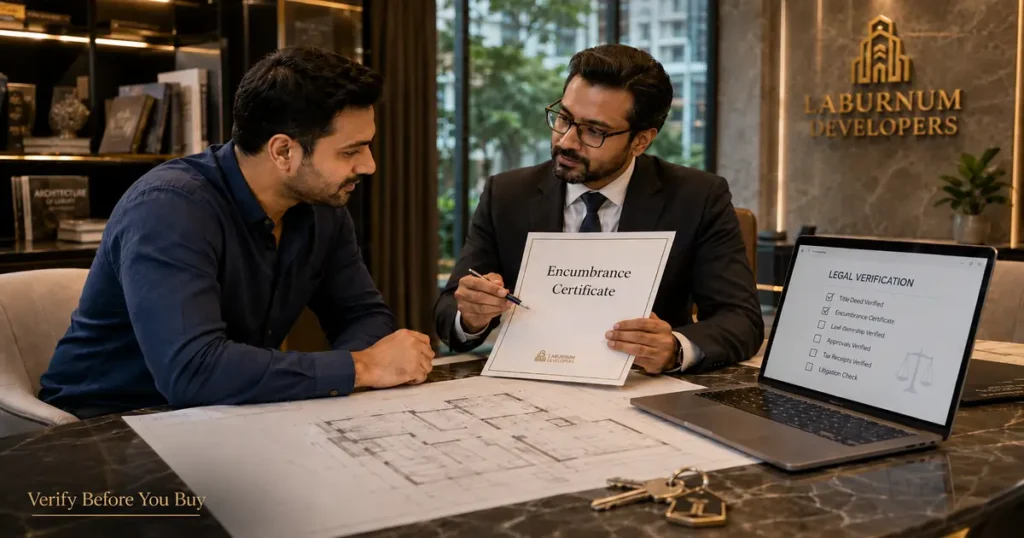
In order to make an investment in the 3 BHK luxury flat in Gurgaon or the luxury builder floor in Gurgaon, you would want to get it perfectly and certainly ensure that the property has clear and undisputed ownership titles. To do this, it is the responsibility of every property buyer to obtain the EC, which is the Encumbrance Certificate.
Here is what would make this document so essential:
1. It Verifies Clear Ownership
The EC provides an unbroken history of ownership – showing how ownership was transferred from one person to another over time. Any gap or discrepancy can be a cause for alarm and could suggest ownership problems, claims against the title, or title fraud.
2. Banks Require It Before Approving Home Loans
Whether it’s a loan for a 3 BHK builder floor or for a luxury builder floor of 4 BHK, the lender always requires an EC for the approval of a home loan. It is because the guidelines issued by the Reserve Bank of India require banks to check if there are any previously made encumbrances on the property offered as collateral.
3. It Protects You from Fraud
Real estate fraud is a genuine risk in high-demand property markets like Gurgaon. A seller could attempt to transfer a property that is already mortgaged, disputed in court, or co-owned by multiple parties. The EC exposes all of this.
4. It’s Required for Property Registration and Mutation
The EC certificate is an essential document for registering a property with the Sub-Registrar’s office or applying for mutation (change of title deed in revenue records) to claim rights in your name.
5. It Helps Legal Heirs Prove Clean Ownership
On transmission via inheritance, EC enables legal heirs to identify that the property does not bear any pending debts or encumbrances.
What Does an Encumbrance Certificate Contain?
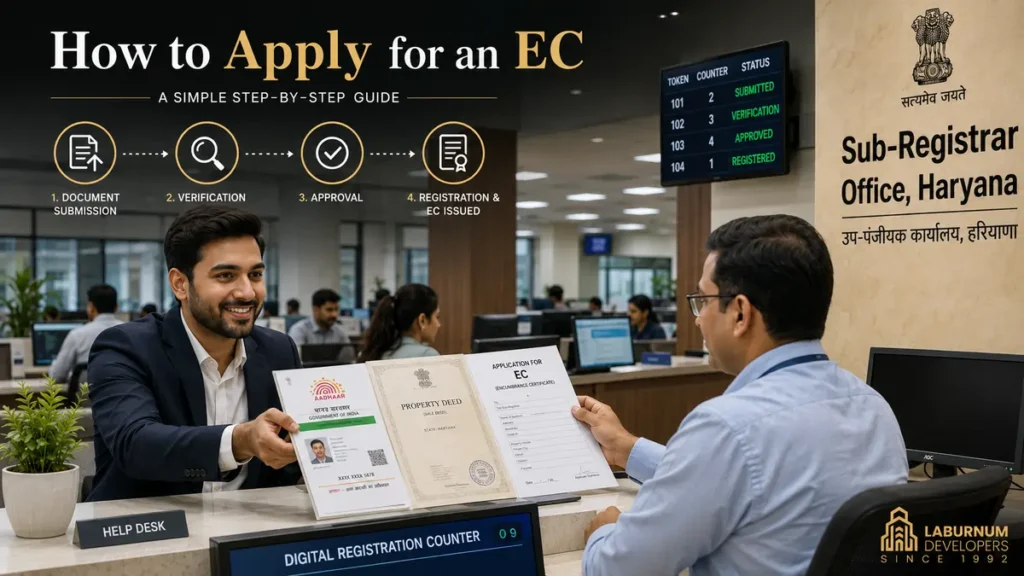
A standard Encumbrance Certificate in India contains the following information:
- Description of the property: Survey number, plot number, location, boundaries, and extent (area)
- Name of current and previous owners as per registered deeds
- Nature and details of each registered transaction: This includes sale deeds, gift deeds, mortgage deeds, lease deeds, court attachments, and release deeds
- Date of registration of each transaction at the Sub-Registrar’s Office
- Document and volume numbers for each registered deed
- Period covered: The specific years for which the EC has been generated (typically 13 to 30 years)
- It’s important to understand that the EC only reflects registered transactions. Family settlements, oral agreements, or unregistered partitions will not appear on the certificate. This is why it’s always advisable to cross-verify the EC with other documents such as the title deed, mutation certificate, and property tax receipts.
Types of Encumbrance Certificates: Form 15 and Form 16
The EC in India comes in two forms, depending on the property’s transaction history:
Form 15 – Encumbrance Certificate
When will Form 15 be provided? Form 15 will be provided if one or more transactions registered on the property have happened in the requested period, such as a purchase deed, lease, mortgage, gift deed, court attachment, etc. Each deed in Form 15 comprises details of the deed type, concerned parties, and details of the registration of the said deed.
Receiving Form 15 is not automatically a cause for concern. What matters is whether the transactions recorded are clean — for example, if a mortgage shows up but there is also a corresponding mortgage release deed, it means the loan has been repaid, and the property is now free of that encumbrance.
Form 16 – Nil Encumbrance Certificate
Form 6 is what is generated when there are no recorded transactions on the property within the period you’ve applied for. Commonly known as a Nil EC (or NEC – non-encumbrance certificate), this should be good news for any buyer of the property, indicating there are no recorded financial or legal burdens on that property title.
For very old properties, a nil EC still needs to be considered – not all past transactions may be available for examination if not previously logged on computer systems.
How to Apply for an Encumbrance Certificate in Gurgaon (Haryana)
Getting an EC in Gurugram is a relatively straightforward process, though it involves a visit to the Sub-Registrar’s Office since Gurugram does not currently issue ECs fully through an online-only self-service mode.
Documents You Will Need
- A copy of the latest sale deed or title deed
- Property details: plot number, survey number, location, boundaries
- Duly filled Form 22 (application form for EC)
- A valid government-issued identity proof (Aadhaar, PAN card, Voter ID)
- Details of the period for which you require the EC (e.g., last 13 or 30 years)
Step-by-Step Process
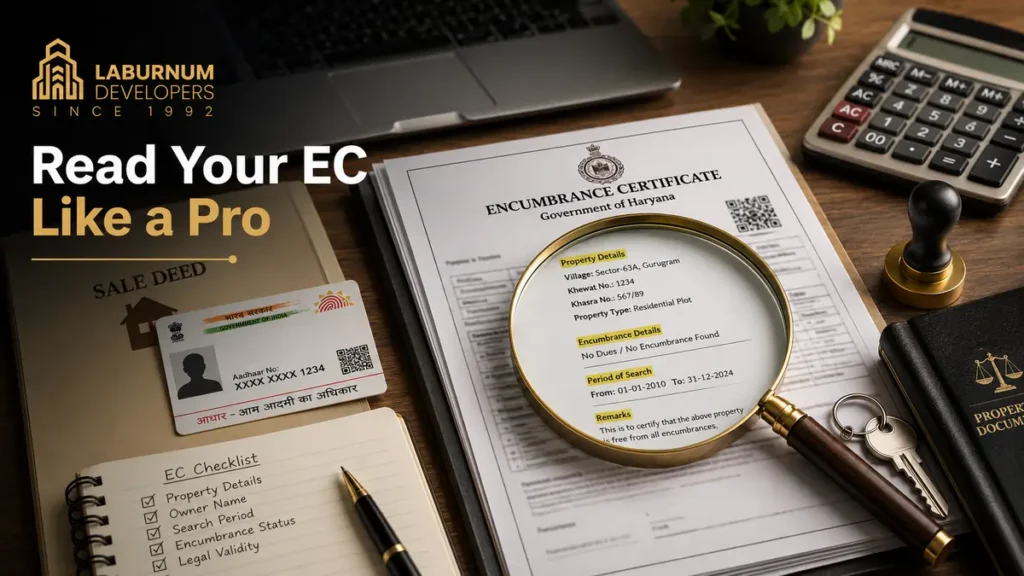
Step 1: Go to the Sub-Registrar’s Office(SRO) at the location where the property you wish to purchase is located. In Gurugram, several SRO offices serve various zones.
Step 2: Obtain the prescribed form ‘Form 22’ either from the office counter or by downloading it from the Jamabandi Haryana Portal jamabandi.nic.in.
Step 3: Fill in Form 22 clearly with all property information, including how long you require the EC, the survey/plot number, and the khasra number (where applicable).
Step 4: Upload a photocopy of the title deed of the property, proof of identity, and any other document as may be required by SRO.
Step 5: Pay the Fees and Other Charges. Fees, etc., may be nominal most years, and the urgent/tatkal charges may vary from the standard fee.
Step 6: Ensure you obtain the receipt after payment and keep a note of the application reference number.
Step 7: Your Encumbrance Certificate. Your Encumbrance Certificate usually reaches you in 7-15 working days. At the Tehsil, however, you may obtain EC within 24 – 48 hrs. Now you have obtained the Encumbrance Certificate after reviewing.
Checking the Status
Anyone interested can review the EC’s status by checking at the SRO where the form was filled out. Along with tracking the progress of their EC application, candidates can also check if a certificate is genuine on the Haryana Land Records Portal (jamabandi.nic.in).
How to Read and Interpret an Encumbrance Certificate
Legal notices. The EC looks intimidating due to its legalistic, cramped text. Let’s systematically decode:
Step 1 – Verify Property Details
Ensure the survey number, plot number, boundaries, and location match exactly with the record. The discrepancies could suggest wrong records.
Step 2 – Confirm the Period Covered
You need to ensure the EC you obtain also includes the period for which you wanted a property search done. Banks will generally look for a minimum of 13 years for a house loan. To perform sufficient diligence, the searches needed are a minimum of 30 years.
Step 3 – Read Transactions from Oldest to Newest
Follow this up from the most recent to the earliest, i.e., the claimant in one transaction should be the executant of the next transaction, not the claimant in another (this will indicate the broken chain of title).
Step 4 – Check for Pending Mortgages
Scan for mortgage deeds and see if one shows, but then no follow-up mortgage deed to release it. If so, there may be an outstanding loan on the property. Check this with the owner/seller and the lender.
Step 5 – Identify Any Court Attachments
Court orders or attachments that may appear on an EC mean the property is potentially involved in existing litigation. Wait until all of this is resolved before you take any action.
Step 6 – Confirm the Current Owner
The EC should specifically display the name of the existing owner. Corroborate with the sale deed and other proofs of ownership to verify that the vendor has legal title and the right to transfer possession of the property.
Common Situations Where You Need an Encumbrance Certificate
The EC is not just needed at the time of purchase. Here are all the situations where you’ll be asked to furnish one:
- Buying a residential property – flats, builder floors in Gurgaon, plots, or villas
- Selling a property – to prove to the buyer that the property is free from liabilities
- Applying for a home loan or a loan against property is a mandatory requirement for all banks and NBFCs
- Property registration – required at the Sub-Registrar’s Office
- Property mutation – to update revenue records after a purchase
- Inheritance claims – for legal heirs proving clear ownership
- Updating land tax records – the village or panchayat officer requires an EC when property tax has not been paid for over three years
What If the EC Shows Encumbrances?
Finding encumbrances on the EC doesn’t necessarily mean you should abandon the property. What it means is that you need to investigate further. Here’s what to do:
- If a mortgage appears, ask the seller to provide a mortgage release deed showing the loan was repaid. You can also verify this with the lending bank directly.
- If a court attachment appears, consult a property lawyer before proceeding.
- If there are multiple ownership claims, get legal advice to understand who holds the valid title.
- If the EC reveals undisclosed co-owners, the property cannot be sold without their consent.
Any confirmed encumbrance must be resolved and cleared before the property can be legally transferred to the new buyer.
Encumbrance Certificate and Builder Floor Purchases in Gurgaon
The last decade has witnessed a huge expansion in real estate in Gurgaon, and of these, the builder floor remains a chosen and affordable alternative for homeowners in areas like the Dwarka expressway, Sohna road and Southern Peripheral road Whether it be a comfortable 3 BHK builder floor in Gurgaon to own or a lavish 4 BHK luxury builder floor with its private terrace and dedicated parking space, the one thing you shouldn’t overlook is the EC check.
When purchasing property, a reputable developer has likely cleared a land title search for encumbrances; however, it is your right and your responsibility to check the Encumbrance Certificate before finalizing the sale of any property that you are buying.
Our builder floors in Gurgaon, for instance, our Victory Floors, are all located on a plot with a verified and clear land title. The EC verification process is open to every buyer before a purchase decision can be made.
So when you’re looking at our selection of 3 BHK builder floors and 4 BHK builder floor apartments, do contact us, and we can guide you.
EC vs. Other Property Documents: Understanding the Difference
Many buyers confuse the Encumbrance Certificate with other property documents. Here’s a quick comparison:
All of these documents together form the complete legal due diligence package for any property purchase. The EC is the foundation — it’s typically the first document any lawyer or bank will review.
Validity of an Encumbrance Certificate
EC never expires. … It only reflects property status up to the issue date. So if any transaction gets recorded, its EC immediately expires.
- Banks and financial institutions typically require an EC issued within the last 3 to 6 months.
- For legal transactions and property registration, a fresh EC is recommended.
- If any new transaction has occurred since the EC was issued, a new certificate must be obtained.
This is why it’s advisable to obtain the EC close to the actual date of your property purchase and not rely on an older one provided by the seller.
Frequently Asked Questions (FAQs)
Q1. What is an Encumbrance Certificate, and why do I need it before buying a property?
An Encumbrance Certificate, issued by the office of the Sub-Registrar, records all the financial and legal activities for a property over a span of time. You require this before purchasing any property — a builder floor in Gurgaon included — so that you can ensure that the current property owner has undisputed property rights over it and that it has no outstanding loans, mortgages, court cases, or any claims by third parties. If you don’t find the property’s encumbrance certificate, you might end up with the previous owner’s legal/ financial baggage.
Q2. What is the difference between Form 15 and Form 16 in an Encumbrance Certificate?
Form 15 is also the encumbrance certificate, which is issued by the registrar if there is one or more such documents, such as sale deeds, mortgage documents, or court attachments, regarding the property in question for a specific duration. Form 16 is the Nil encumbrance certificate, which is provided when no such documents about property registration in the requested time span have been registered. Form 16 should generally give a buyer confidence in the property; however, it should always be matched with property records.
Q3. How do I apply for an Encumbrance Certificate in Gurgaon?
In Gurugram, the EC can be obtained from the concerned Sub-Registrar’s Office (SRO) in whose jurisdiction the property falls. You’d be required to visit the SRO and fill out Form 22 with details about the property (plot/survey number, location, boundary specifications), proof of property ownership in the form of a copy of your title deed, and identification proofs. After submitting the EC fee, it is usually issued within 7 to 15 business days. You can check land records on the Jamabandi Haryana Portal.
Q4. Is the Encumbrance Certificate mandatory for getting a home loan?
You’re absolutely right, the EC is one of the essential documents requested by banks and financial institutions before a home loan can be sanctioned. According to RBI regulations, lending institutions need to be assured that there is no pre-existing charge or claim against the property mortgaged to back your home loan. Very few banks will grant a home loan without the clarity of an EC, no matter how impressive your credit score might be.
Q5. What should I do if the Encumbrance Certificate shows a pending mortgage?
If the deed/EC states the property has a mortgage or a lien, DO NOT buy the property until the encumbrance/charge has been paid in full and a “Mortgage Deed release” has been obtained from the bank, which states clearly that the mortgage has been released and paid by the owner of the property. If it is not paid, it will take more time; the seller has to clear the payment. It would be a good idea to go to the lawyers for the advices in regards to the purchase once any charges appear in the certificate.
Q6. Does an Encumbrance Certificate cover all transactions on a property?
Not at all, because only those transactions that are registered with the Sub-Registrar’s office are reflected in the EC. Family settlements not registered, any agreements made orally, partitions made without registration, or equitable mortgages (where the title deeds are deposited without any registration) will not figure in the EC. That is why the EC needs to be considered along with other documents,s such as the title deed and mutation record.
Q7. How long is an Encumbrance Certificate valid?
There is no specific expiry period for an EC; however, it is said to be valid only till the issue date. As it will not show any transaction done after that particular date, both the buyer and the bank tend to favor an EC issued in the past 3 to 6 months. In case of significant deals, such as buying property or applying for a loan, an updated EC must be taken.
Q8. Can NRIs apply for an Encumbrance Certificate for a property in Gurgaon without visiting India?
Yes, NRIs can make the EC at the relevant Sub-Registrar’s Office in Gurgaon. Some of these locations have records that are visible through the Jamabandi Haryana portal (online). Other than that, an authorised professional working for you can make the physical application on your behalf and get a physical copy of the EC from the Sub-Registrar’s Office, Gurgaon. If you,u as an N, are investing in a 3 BHK luxury apartment or a 4 BHK luxury builder floor in Gurgaon, then you have to ensure that this is completed.
Final Thoughts
The decision to buy a home is probably one of the most important financial decisions that you will ever make in life. From a 3 BHK luxury flat in Gurgaon to the exclusivity of a 4 BHK luxury builder floor, every purchase should be made only after rigorous legal checks.
An Encumbrance Certificate comes in as your best protection. Not only does it give you an idea of what the property is like on paper, but it also shows you exactly how the property has been in reality up to now. A clear encumbrance certificate will give you peace of mind, whereas an encumbrance certificate with entries will give you all the information that you need to back out or negotiate from.
At Laburnum Developers, we believe that the more knowledgeable the buyer is, the better it is for everyone. Are you ready to invest in builder floors in Gurgaon? Here’s where to start.
Read Also… Revolutionizing Real Estate: Impact & Benefits of RERA ACT
Read Also…. Luxury Residential Property: A Look Into the Most Prestigious Locations in Gurgaon
Read Also… 3BHK Builder Floor in Gurgaon Under 2 Crore: The Smartest Buy of 2026?



Comments are closed